
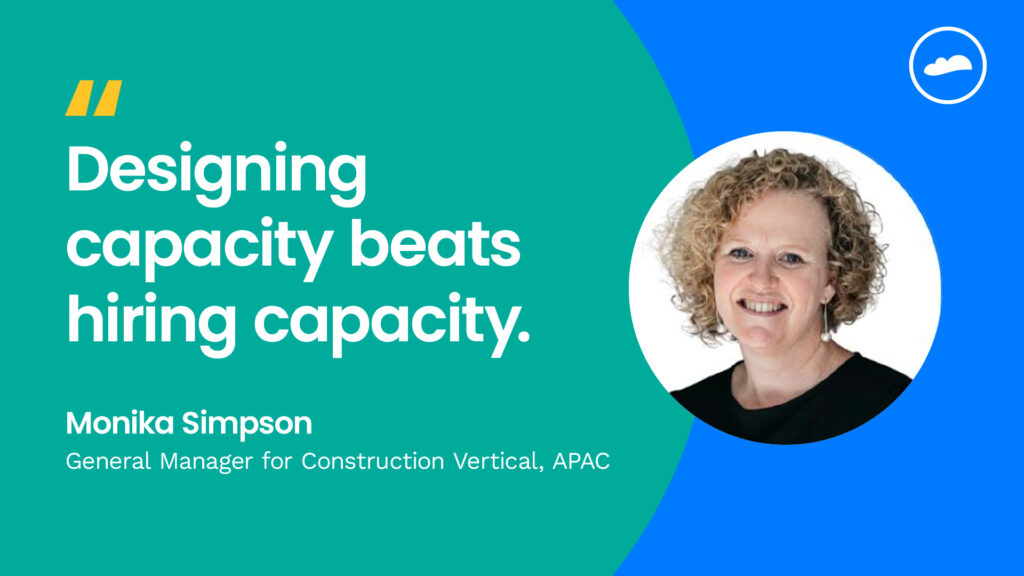
By Monika Simpson
The construction industry workforce shortage is fundamentally reshaping how work gets distributed.
I’m hearing the same pattern in my conversations across APAC. Senior engineers are absorbed by document control, version management, and coordination admin. Infrastructure Australia’s 2025 Market Capacity Report confirms the skills shortage will persist well past 2027.
The challenge extends beyond headcount to how capability is allocated.
When experienced professionals handle low-value tasks because there’s no structured alternative, capacity tightens faster than any hiring plan can solve. I’ve seen this firsthand with companies navigating major projects.
What’s Driving the Gap
Three forces are compounding across APAC’s construction sector and engineering sector:
1. Construction industry growth outpacing supply
Queensland is leading Australia’s construction projects boom right now. Gold Coast has Australia’s fastest-growing economy and is the fastest-growing non-capital city. Brisbane is expanding rapidly with $7.1 billion in infrastructure development for the 2032 Olympics, including 17 new and upgraded venues. From my discussions with leaders in the region, the demand for commercial and residential projects plus infrastructure projects to support those is increasing faster than the talent pool can keep up.
2. Demographic pressure – ageing workforce
An ageing workforce means experienced workers are retiring faster than we can implement replace them. Workforce development is slow to bring in new skilled workers.
What’s interesting is the ageing population also drives continued demand for more housing projects. It’s a double squeeze on capacity that every Australian construction leader I speak with is feeling.
3. Technical complexity increasing
Buildings are smarter now, and I’m seeing how new technologies and digital transformation add layers of complexity. Modern construction process requires more coordination from start to finish. Electricians handle security system setup. Plumbing services need to integrate with smart home tech. Every process of a property now requires tighter coordination, adding documentation and administrative load at every project stage.
The result? Companies hit delivery limits earlier than planned, despite healthy project pipelines.
The Question That Changes Everything
In my conversations with leaders across the region, one question consistently comes up:
“What roles can companies expand or offshore without compromising delivery quality or compliance?”
This shifts the conversation from hiring capacity to designing capacity.
The construction and engineering companies I work with who are maintaining quality and efficiency to meet deadlines are fundamentally restructuring how work flows through their organisations.
The Role-Based Capacity Model
After analysing delivery models across Australia, New Zealand, and Southeast Asia, I’ve observed three role categories that work.
Role Category 1: Standards-Driven Execution
Work governed by established technical standards with clear review cycles.
High-demand examples:
- Accounting and financial administration
This is hands down the easiest role to outsource and the most requested across the industry. I see companies successfully scaling bookkeeping, accounts payable and receivable, payroll processing functions, and financial reporting with offshore teams. It’s usually the first role companies expand because the processes are well-defined and the impact is immediate.
- CAD drafting and BIM modelling
Technical work in AutoCAD, Revit, and Navisworks that follows defined standards. These roles thrive when there are clear review processes in place.
- Quantity surveyors and estimators
I’m seeing experienced professionals working closely with onshore teams on take-offs, construction costs estimation, and tender preparation. When integrated properly, these roles can significantly accelerate project timelines.
- Engineering documentation and version control
Managing document workflows, version tracking, and project documentation. This is where senior engineers often get bogged down when there’s no structured alternative.
The principle:
Final review and statutory sign-off remain onshore. Execution and productivity scales through dedicated teams working within defined standards.
Impact:
Senior Engineers and Project Managers reclaim significant time for design leadership, innovation, labour management, and oversight. I’ve watched teams transform when they get this time back.
Role Category 2: Coordination and Planning Support
Process-intensive work requiring accuracy and consistency.
Examples:
- Council approvals and submissions
This is a major pain point I hear about constantly. More documentation is now required for each project, slowing down every stage. Documentation preparation for council submissions can be reallocated, freeing senior staff from the administrative parts of approval processes so they can focus on strategic planning and client engagement.
- BIM coordination assistance
Supporting clash detection, model coordination, and integration across disciplines.
- Project reporting and status tracking
Maintaining project documentation, progress reporting, and stakeholder updates.
- Compliance documentation preparation
Preparing quality assurance data, compliance reports, and regulatory documentation.
The principle:
Clear workflows, secure access controls, and embedded quality checkpoints integrate these roles into existing delivery systems. The companies doing this well invest in documented procedures upfront, creating consistency and enabling continuity.
Impact:
Reduces friction between design and execution phases while maintaining continuity.
Role Category 3: Onshore Accountability
What stays local:
- Statutory engineering sign-off
- Licensed approvals
- Final client accountability
- Risk and commercial decision-making
The principle:
These roles define project governance. Capacity expansion supports these responsibilities rather than attempting to replace them.
By removing low-value tasks from senior professionals and stabilising workload cycles, companies free up the experienced capability needed to exercise judgment, manage risk, and maintain quality. I’ve seen this approach work consistently across different company sizes and project types.
The Pressing Issue: Ensuring Quality
Concerns about quality and compliance in distributed teams come up in nearly every conversation I have. They’re valid concerns, particularly in regulated environments.
What I’ve learned is that quality emerges from deliberate system design.
The principles that work:
- Defined responsibility matrices
Every task has a clear owner and approval authority. Ambiguity creates risk.
- Standards-aligned secure environments
Teams work within the same technical standards, data security protocols, and compliance frameworks as onshore staff.
- Embedded quality checkpoints
Reviews are not separate inspection layers and happen at natural workflow transitions.
- Structured onboarding and documentation
Companies that manage distributed teams well within the Australian construction industry invest in setup support from day one. This includes creating procedure documents, establishing workflows, and building documentation systems that ensure consistency. I work with teams on this structure, and the difference it makes is significant.
- Long-term team relationships
Continuity matters more than supervision. Teams that understand your project contexts and standards deliver consistently. The most successful setups I see are built on long-term relationships instead of transactional arrangements.
When these principles are operationalised, distributed teams reinforce quality.
Capacity as Strategic Infrastructure
Infrastructure Australia’s report projects capacity constraints will continue reshaping the construction and engineering landscape well past 2027. With general growth pressures and major events like the 2032 Olympics, demand will remain strong while talent pools stay constrained.
From what I’m seeing across the region, capacity is functioning as strategic infrastructure.
By reallocating standards-driven work, freeing senior professionals from misallocated tasks, and designing quality into workflows, organisations can smooth workload peaks and maintain delivery standards under pressure.
How work is structured increasingly defines competitive advantage in this market.
What This Means for Construction Sector Leaders
The construction workforce shortage requires sustained strategic response.
Companies that maintain quality, compliance, and delivery velocity will move from reactive hiring to strategic capacity design. I’m watching this shift happen in real time.
That means:
- Auditing where senior capability is currently absorbed
- Identifying which roles fit the standards-driven or coordination categories
- Building delivery systems that integrate distributed teams with clear accountability
- Measuring capacity by output quality and timeline adherence alongside headcount
The approach focuses on structuring work so quality, compliance, and your people stay protected as demand grows.
About the Author
Monika Simpson is the General Manager for Construction and Engineering at Cloudstaff, where she works with construction, engineering, and design companies across APAC to build delivery models that support growth without compromising quality or compliance. With deep experience in workforce strategy and operational delivery, Monika focuses on helping teams design sustainable capacity so local professionals can stay focused on high-value work.
Want to explore how companies are dealing with the construction workforce shortage? Learn more about Construction Back Office Operations Outsourcing.