
In remote staffing, efficiency is often measured by speed; how swiftly you can hire, onboard, and start seeing results. While speed is undeniably important, it can become a double-edged sword if security isn’t embedded into the process from the very beginning.
Cutting corners to accelerate hiring or onboarding might seem like a time-saver, but it can expose your organization to significant risks, such as data breaches, compliance issues, or even reputational damage.
The key is to strike a balance between speed and security. By investing in robust security measures upfront—such as thorough background checks, secure onboarding protocols, and clear cybersecurity policies—you create a strong, secure foundation.
This doesn’t mean you’re locked into a rigid system; rather, it allows you to focus on adapting to new threats and challenges as they arise, rather than constantly scrambling to fix vulnerabilities that could have been prevented.
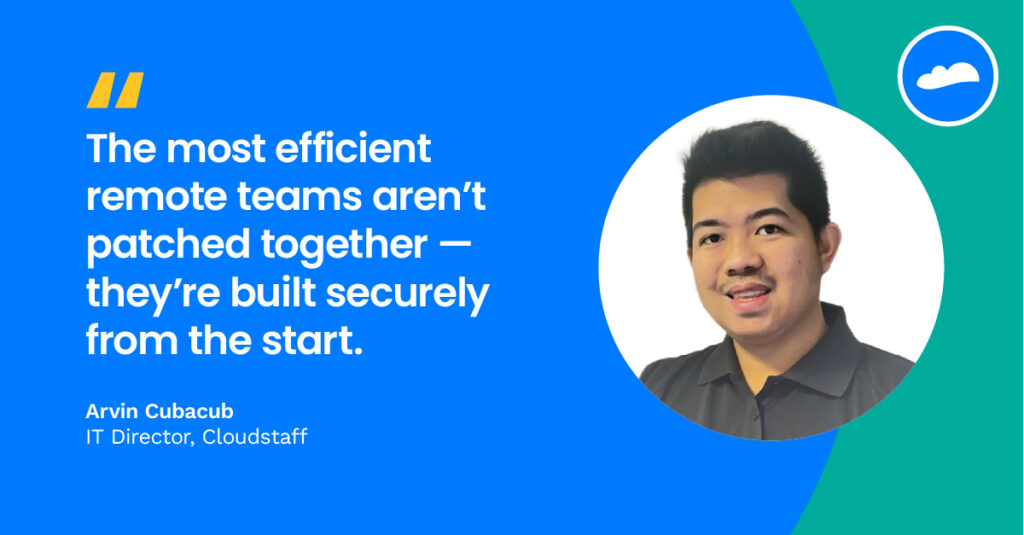
“If you get a lot of things right at the start, you build an inherently secure foundation. That doesn’t mean you stop iterating—it means you’re adapting to new threats, not constantly patching old ones.”
Why Technology-Led Security Matters
Efficient remote staffing goes beyond simply sourcing talent quickly—it’s about sustaining productivity, trust, and compliance in a distributed environment. The cornerstone of this efficiency is a secure infrastructure, which includes:
- Endpoint and network controls to protect devices and data.
- Least-privilege access by default to minimize exposure to sensitive information.
- Real-time visibility and anomaly detection to identify and address threats instantly.
- Regular security simulations and training to ensure all roles are prepared for potential risks.
- Vendor ecosystems that align with your security standards to maintain consistency across partnerships.
When these elements are integrated from the outset, they operate smarter, in addition to doing it faster. This proactive approach not only mitigates risks but also builds a resilient foundation that supports long-term success in remote staffing.
The Qantas Wake-Up Call
In July 2025, Qantas experienced a major data breach, reportedly traced back to a third-party contact center. Attackers used a single vishing call — a form of phone-based social engineering — to access sensitive customer data including names, contact information, and frequent flyer balances.
This wasn’t a failure of technology. It was a breakdown in process and awareness.
Remote staffing depends on trust across extended teams, including third-party vendors. When partners aren’t held to the same high security standards, every endpoint becomes a potential vulnerability.
This incident reinforces the need for strong, shared standards — and ongoing awareness — to protect customers and operations in a globally distributed model.
Security Built In, Not Bolted On
Security works best when it’s built into remote work systems from the start. This means focusing on scalable, adaptive practices that grow with your organization. Here’s how:
Design secure workflows alongside secure apps
Security doesn’t start and end with the tools, it’s about how work flows. By embedding safety into every step of your processes, you reduce risks and create a more resilient system.
Integrate third-party risk into operational planning
Third-party vendors are part of your team, and their vulnerabilities can impact you. Holding them to the same standards and managing their risks as part of your operations strengthens your overall defense.
Embed compliance into every stage, from hiring to daily tasks
Compliance is an ongoing effort, not a one-time task. Ensuring it’s part of recruitment, onboarding, and daily operations builds a culture of accountability and trust.
When security is foundational, it becomes a natural part of your remote work strategy. This approach not only protects your organization but also drives efficiency and confidence in a distributed environment.
What to Ask Before Scaling Remote Teams
When choosing a staffing provider or developing in-house capabilities, it’s essential to ask the right questions to ensure security is a priority. Here’s what to consider:
1. Are access controls based on least privilege?
This means ensuring employees and systems only have access to the data and tools they absolutely need. Limiting access reduces the risk of accidental or intentional misuse.
2. Are social engineering threats being simulated and tested?
Phishing, vishing, and other social engineering attacks are common. Regular simulations and training help teams recognize and respond to these threats effectively.
3. Can systems detect and respond to anomalies in real time?
Proactive monitoring and quick response to unusual activity are critical. Real-time detection minimizes damage and keeps operations running smoothly.
4. Does the culture treat security as everyone’s responsibility?
Security isn’t just the IT team’s job, it’s a shared responsibility. A culture where everyone is aware and accountable creates a stronger, more resilient organization.
By asking these questions, you ensure that security is embedded into every aspect of your staffing strategy, whether outsourced or in-house. This approach not only protects your organization but also builds trust and confidence in your remote work environment.
Designing for Secure Efficiency
The best approach to security is simple—something like we have at Cloudstaff:
If we get a lot of things right at the start, we build an inherently secure foundation. That doesn’t mean we stop iterating, it just means our focus shifts to adapting to new threats, rather than constantly patching major gaps.
We also believe that security is everyone’s responsibility. Our layered approach combines both people and technology, creating a strong and resilient security posture. It’s not perfect, because no system ever is, but it’s built to adapt, evolve, and stay ahead.
The most efficient remote staffing solutions are secure by design—and enabled by the right technology from the ground up. No system is perfect, but the right foundation enables agility without compromise.
Security isn’t just a feature—it’s the foundation of remote work that actually works.
About the Author
Arvin Cubacub is the IT Director at Cloudstaff, where he leads global infrastructure, cybersecurity, and digital operations across enterprise outsourcing environments. With 10 years of experience in systems engineering, process automation, and secure IT architecture, Arvin is passionate about building resilient, high-performing remote teams through technology and trust.
Secure remote teams start with the right technology foundation. 🔒 See how Cloudstaff’s technology keeps businesses secure →