
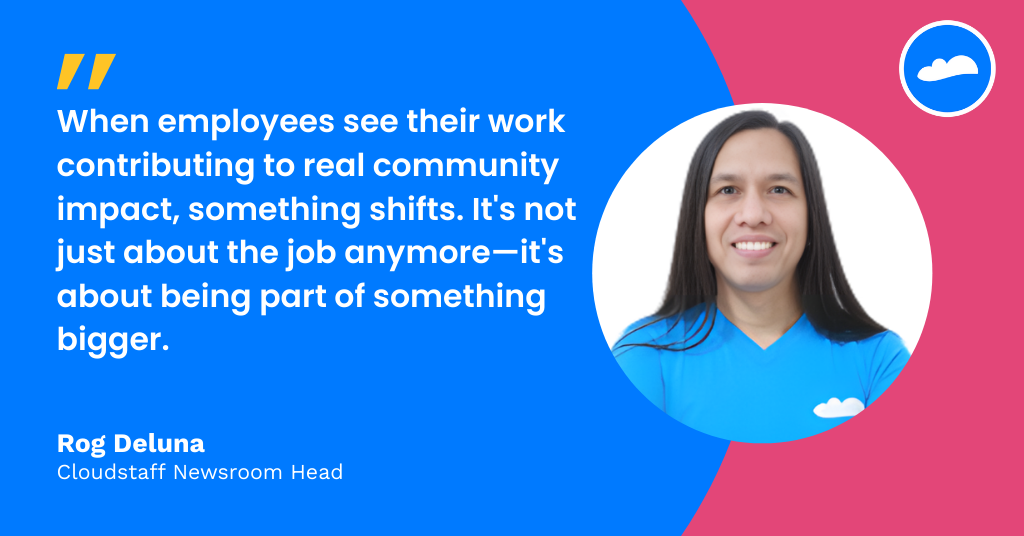
By Rog Deluna
At almost 25 years in the modern workforce industry and countless hours spent building employee engagement initiatives, I’ve learned something critical: the programs that create the deepest employee connections aren’t always the ones you’d expect.
Sure, team building activities and recognition programs matter. But nothing (and I mean nothing) creates the kind of lasting engagement I’ve seen from well-executed CSR initiatives.
Let me share what I’ve learned from the ground level.
The Breakfast That Changed How I Think About Engagement
A few weeks ago, our Cloudstaff Cares team organized an event at Duyan ni Maria and Send The Light Foundation in Mabalacat, Pampanga. These homes provide shelter, education, and care to children who’ve been abandoned, abused, or orphaned.
We went in planning to serve breakfast and donate essentials (rice, fruits, condiments, milk, vitamins, and diapers). Standard CSR stuff, right?
What happened instead was something I didn’t fully anticipate, even after years of running these programs.
I watched our team members (people who work in high-pressure client environments every day) sit down with these kids. Really sit down. Listen to their stories. Share moments that have nothing to do with KPIs or deadlines or quarterly targets.
And when we got back to the office, something was different. The energy. The conversations. The way people talked about being part of Cloudstaff Cares or just CS Cares
That’s when it crystallized for me: CSR isn’t a nice-to-have. It’s a retention strategy hiding in plain sight.
What the Data Won’t Tell You (But I Will)
Look, I can cite the statistics. Research shows that 86% of employees say it’s important to work for a company whose values align with their own (Fidelity Charitable, 2023). Companies that prioritize CSR see a 35% increase in employee retention over five years (Procurement Tactics, 2025). Organizations investing in corporate social responsibility report a 13% boost in employee engagement scores (Vorecol). Community outreach is a central component of the Social (S) pillar of the Environmental, Social, and Governance (ESG) framework.
The numbers are compelling. But here’s what those statistics don’t capture:
The look on someone’s face when they realize their company doesn’t just talk about values. It acts on them.
In a modern workforce world, we’re often bridging gaps (between clients and customers, between time zones, between cultures). Our people are good at caring, at problem-solving, at showing up.
When you give them a chance to channel those same skills into community impact, you’re not creating engagement. You’re revealing what was already there.
Five Things CSR Does That Your Engagement Budget Can’t Buy
1. It Creates Meaning, Not Just Motivation
Motivation is temporary. Meaning is permanent. When employees contribute to causes that matter (especially when they can see the direct impact), they connect their daily work to a larger purpose. That sense of purpose doesn’t expire at the end of a fiscal quarter.
2. It Builds Teams Through Shared Values, Not Just Shared Tasks
Collaboration exercises are fine. But put your team in a situation where they’re working together to support vulnerable children, and watch what happens. The bonds formed through meaningful action are deeper than anything a ropes course can create.
3. It Gives Employees a Story They’re Proud to Tell
Your people talk about where they work. At family dinners, at reunions, online. When they can say, “My company actually makes a difference in our community,” that’s not just pride. It’s advocacy. And advocacy is how you attract the next generation of talent.
4. It Addresses Burnout in Ways Wellness Programs Can’t
I’m not dismissing wellness initiatives. But sometimes, the best antidote to feeling drained by your work is remembering why it matters. CSR programs provide that perspective shift. They remind people that their contributions (whether at work or in the community) have value.
5. It Tests Culture in Real Conditions
You can claim to have an empathetic, caring culture. CSR programs prove it. When you prioritize community impact alongside business goals, you demonstrate that your values aren’t just corporate speak. They’re operational principles.
The Retention Connection You Might Be Missing
Here’s something I’ve noticed: the employees most engaged in our CSR initiatives are often the ones with the longest tenure.
Coincidence? I don’t think so. And the research backs this up. Companies see a 52% lower turnover rate among newer employees who participate in corporate purpose programs (Benevity Impact Labs). Meanwhile, 46% of employees say they’re considering leaving their company because it doesn’t adequately exemplify the values they personally hold (Qualtrics, 2022).
When someone has been with your organization for years, it’s rarely just about the paycheck or even career growth. They stay because they believe in what the company stands for. CSR programs strengthen that belief.
And for newer employees? These initiatives become early proof points. They’re watching to see if your culture is real or performative. Show them community impact in their first 90 days, and you’re not just onboarding. You’re embedding.
Making CSR Work: What I’ve Learned
Not all CSR programs drive engagement. I’ve seen plenty that feel like box-checking exercises. Here’s what separates the programs that resonate from the ones that fall flat:
Authenticity Over Optics Choose causes that align with your actual values and your employees’ passions. Don’t just pick what looks good in a press release.
Participation Over Observation Let employees get their hands dirty. Direct involvement creates emotional investment in a way that writing a check never will.
Consistency Over Campaigns One-off events are fine, but sustained commitment shows employees that this matters to the organization. Regular CSR activities become part of who you are, not just what you occasionally do.
Stories Over Statistics Share the human impact. Yes, talk about the number of meals served or supplies donated. But also share the moments (the conversations, the smiles, the connections made).
What I’d Tell My Younger Self
If I could go back to when I started building the Newsroom Department and CS Radio at Cloudstaff, I’d tell myself this: The engagement initiatives that feel most “soft” often deliver the hardest business results.
CSR programs seemed secondary to me then (nice additions after you’ve handled the “real” engagement work). Now I understand they’re not additions. They’re foundations.
When employees see their organization investing in community welfare, supporting vulnerable populations, and creating tangible positive change, they don’t just feel engaged. They feel aligned.
And alignment is what keeps people from browsing job boards when a recruiter reaches out.
The Challenge I’ll Leave You With
If you’re leading employee engagement or retention initiatives, I’d encourage you to ask yourself:
- When was the last time your team did something together that had nothing to do with business outcomes?
- Can your employees articulate the community impact your organization makes?
- Are you creating opportunities for them to be part of that impact?
Those questions matter because the answers reveal whether you’re building an engaged workforce or just a satisfied one.
And in an industry where talent is everything, that distinction is the difference between retention and revolving doors.
Moving Forward
The event at Duyan ni Maria and Send The Light Foundation won’t be our last. It can’t be. Not because CSR is trendy or because it looks good on LinkedIn (though it does).
It’s because I’ve seen what happens when you give people a chance to matter beyond their job descriptions. I’ve watched teams transform. I’ve seen retention numbers improve. I’ve felt the cultural shift that happens when a company moves from talking about values to living them.
CSR isn’t the only answer to employee engagement and retention. But it might be the most underutilized one. Consider this: 83% of employees say they would reconsider their jobs if their employer failed to uphold CSR values (Procurement Tactics, 2025). That’s not a retention risk. That’s a retention crisis waiting to happen.
And for those of us who spend our days thinking about how to keep teams motivated, connected, and committed? That’s an opportunity we can’t afford to ignore.
About the Author
Rog Deluna is currently Newsroom Head at Cloudstaff and also leads CSR activities through CS Cares. He is a dynamic communications leader with over 13 years in the BPO industry. Rog has built programs that strengthen employee engagement and foster community connection. His approach combines strategic communication with hands-on community involvement, creating workplace cultures where people want to stay and grow.
Want to know more about Cloudstaff’s award-winning culture? Visit us and see for yourself.