
When sales start climbing and your team is already stretched thin, every business leader asks the same question: How do I scale my workforce quickly without sacrificing quality?
For ecommerce brands, retailers, customer service centers, logistics companies, and financial services companies, seasonal demand spikes can make or break the year. Black Friday, Cyber Monday, Thanksgiving, Christmas, tax season, or even a sudden viral product can overwhelm in-house teams.
These periods bring unique challenges, as businesses must navigate increased workloads, shifting customer expectations, and the need to maintain high performance under pressure. Hiring locally often takes too long, and temporary contracts can be challenging for businesses trying to meet seasonal demand, as they don’t always provide the skill or reliability you need.
The fastest—and increasingly most reliable—answer is building a flexible remote staffing strategy.
Why Traditional Hiring Falls Short
- Time-to-hire is too long: In the U.S., it takes an average of 36 days to fill a new position. That’s far too slow when seasonal peaks only last weeks, and traditional recruiting methods often can’t scale quickly enough to meet urgent seasonal demand.
- Training eats resources: Seasonal staff often need quick onboarding, but constant churn means repeating the cycle again and again.
- Limited local talent pools: In smaller regions, businesses simply can’t find enough people with the right skills at the right time.
This is why many companies are rethinking seasonal hiring through remote staffing solutions.
The Remote Staffing Advantage
Remote staffing changes the equation by letting you tap into pre-vetted talent pools worldwide, without the delays of traditional hiring.
- Faster ramp-up: Established outsourcing providers often maintain “bench” talent who can start within days.
- Scalable teams: Add 5, 50, or 500 seasonal workers—then scale back without the headaches of local contracts.
- Specialized skills on demand: From ecommerce support (order management, product listings, returns processing) to customer service teams trained in peak demand handling, remote staff are already skilled for the role.
- Cost-effective flexibility: With lower overheads and flexible agreements, companies can align labor costs directly with seasonal revenue spikes.
By leveraging these remote staffing strategies, businesses can set themselves up for success during seasonal peaks.
Who benefits most from outsourcing during seasonal demand?
Outsourcing isn’t limited to retail and eCommerce. Other industries also gain significant advantages during peak periods:
- Retail & eCommerce – Customer service, product listing, fulfillment, and returns.
- Logistics & Supply Chain – Shipment tracking, documentation, dispatch coordination.
- Finance & Accounting – Invoicing, reconciliations, and compliance support.
- Hospitality & Travel – Booking management, guest support, and itinerary coordination.
These benefits are especially valuable for industries with remote customer service or tech support staff, especially those that experience unpredictable or high-volume seasonal demand.
Outsourcing providers help their clients by delivering tailored solutions that support their clients’ needs during seasonal demand.
Any business that experiences seasonal fluctuations can benefit from flexible staffing.
Case in Point: Ecommerce During Holiday Rush
During the holiday season in Q4, U.S. ecommerce sales surge by over 30% compared to other quarters. For brands without scalable support, that can mean unanswered customer queries, especially when answering questions is a key responsibility during the holidays, leading to delayed orders and lost sales.
By integrating remote ecommerce support staff—for order processing, live chat, returns, and product catalog updates—companies not only keep up with demand but also assist customers by answering questions and providing support during the holiday rush, maintaining customer loyalty during the most competitive time of year.
Black Friday & Cyber Monday: The Stress Test for Operations During Peak Periods
BFCM is no longer just a weekend, it’s an entire sales season. While traditional seasonal hiring often focused on in-person positions at a retail store, many businesses now turn to remote roles as an alternative to meet increased demand. Outsourcing provides access to specialized roles such as:
- Customer support agents to manage inquiries and complaints.
- Order processing and fulfillment teams to speed up turnaround times.
- Finance and accounting support to handle payment processing, reconciliations, and refunds.
- Logistics coordinators to streamline last-mile delivery and supply chain operations.
How to Get Started Quickly with Remote Seasonal Jobs
- Plan ahead of the peak – Even with faster hiring, give yourself a few weeks for onboarding.
- Identify repeatable tasks – Outsource functions like customer support, data entry, logistics coordination, and digital marketing that are easy to hand over.
- Partner with the right provider – Look for outsourcing firms with industry expertise, a proven workforce, and strong data security practices.
- Use a blended model – Combine your core in-house staff with a flexible remote team to handle spikes.
Outsourcing could be your next best business move
If you’re asking “What’s the fastest way to add remote staff during seasonal demand?”—the answer is to look beyond traditional hiring. Remote staffing solutions give you speed, scale, and flexibility that local seasonal hires can’t match.
Instead of scrambling for temporary fixes, companies that adopt this model build a repeatable seasonal workforce strategy—one that strengthens customer trust and supports long-term growth.
About the Author
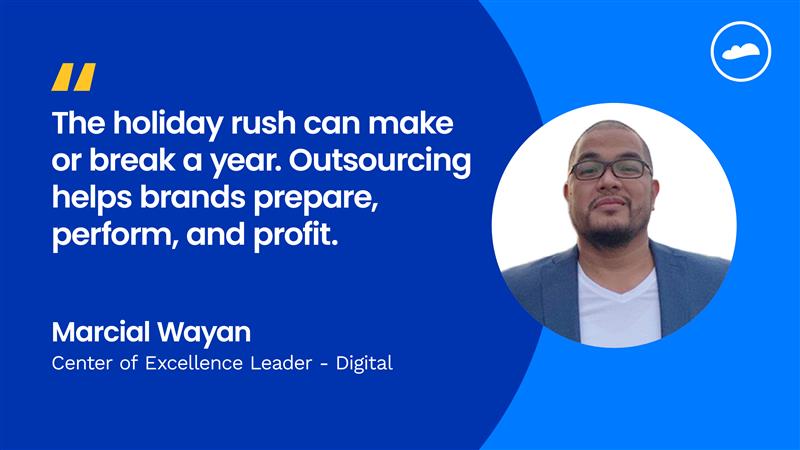
Marcial Wayan, Cloudstaff’s Center for Excellence Manager for Digital, is an Ecommerce Subject Matter Expert and Customer Success leader. With over 15 years of experience across platforms like Adobe Commerce, Shopify, and Salesforce Commerce Cloud, he has helped global brands scale through digital commerce and remote teams. Marcial is passionate about building high-performing ecommerce operations that drive growth and lasting customer success.
👉 Need help preparing for peak demand?
Explore how Cloudstaff helps businesses build flexible, scalable remote teams that deliver during seasonal spikes. Learn more here → Outsourcing Simplified