
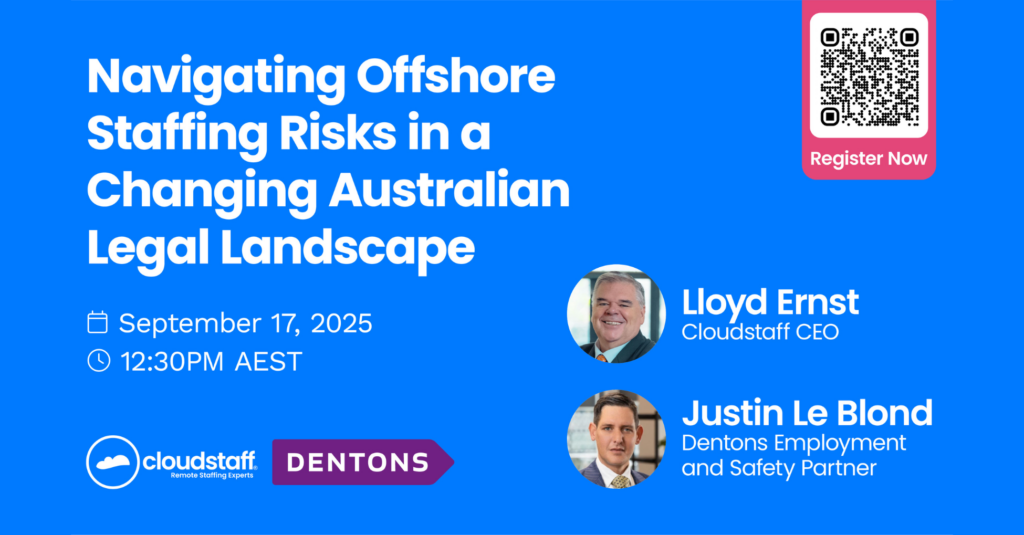
By Justin Le Blond, Partner at Dentons, and Lloyd Ernst, CEO of Cloudstaff
Australia’s legal and tax landscape for offshore workers and contractors is shifting rapidly. Recent rulings by the Fair Work Commission and the NSW Court of Appeal have introduced new responsibilities for businesses that depend on offshore freelancers, gig-economy workers, or contractor setups.
These changes bring a two-fold risk: potential employment law issues on the one hand and payroll tax obligations on the other. Businesses that once saw direct offshore contracting as a low-cost, low-risk alternative to outsourcing may now face compliance challenges with serious financial consequences.
The Fair Work Precedent: Pascua v Doessel Group Pty Ltd
In 2024, the Fair Work Commission handed down its decision in Pascua v Doessel Group Pty Ltd (2024fwc2669).
The ruling confirmed that even if an offshore worker is formally engaged as an “independent contractor,” they may be deemed an employee if the relationship bears the hallmarks of employment – such as fixed hours, direct supervision, and set wages.
This decision has far-reaching implications:
- Many Australian companies that hire offshore freelancers might unknowingly
establish employer-employee relationships as defined by Australian law.
- Liabilities may involve obligations such as unpaid leave, superannuation contributions, or safeguards against unfair dismissal.
- Companies that hire offshore contractors at scale might face unexpected employment law obligations they didn’t plan for.
Legal Perspective (Justin Le Blond): For years, businesses have seen offshore freelancers as a way to save costs, or perhaps directly engaging offshore staff, thinking they are doing the right thing. But the lack of awareness of the laws surrounding this puts businesses at risk. This recent ruling makes clear that labels don’t matter – what matters is the reality of the working relationship. Businesses need to be prepared for that reality.
The Payroll Tax Turning Point: A Landmark Case in the NSW Court of Appeal
Fast forward to 2025, and the NSW Court of Appeal delivered a significant ruling in a case involving a major platform-based business.
The respondent was found liable for over $80 million in payroll tax and interest for payments made to its service providers between 2015 and 2020. The Court applied the “relevant contract” provisions of the Payroll Tax Act 2007 (NSW), focusing on the actual nature of the relationships rather than their formal labels. However, it’s important to note that this case is now the subject of appeal to the High Court of Australia.
Key points from the ruling:
- What mattered was that under the relevant contracts, work was performed for reward.
- The “relevant contract” test captures arrangements that look like independent contracting but function like employment.
- The decision applies not just to ride-sharing, but potentially to healthcare, professional services, and essentially any business relying on contractor models.
Legal Perspective (Justin Le Blond): This judgment underscores that payroll tax liability doesn’t turn on contractual drafting. If work is being performed for payment, and the arrangement resembles an employment relationship, tax authorities are likely to take a firm view.
What are the potential risks of offshore staffing?
The combination of these rulings creates a multi-layered compliance environment:
- Employment Law Risk: Offshore contractors may be deemed employees, with all associated rights.
- Payroll Tax Risk: Payments to contractors may attract payroll tax, even if the business sees them as independent.
- Retroactive Exposure: The ruling shows liabilities can extend years into the past, creating potentially huge financial impacts.
If your business hires offshore workers directly in countries like the Philippines or India, you’re navigating legal responsibilities in both Australia and the offshore location. Misclassifying workers (for example: treating them as contractors when they’re actually employees) can lead to hefty liabilities. You could end up owing back payments for wages, benefits, and payroll taxes in both places. It’s a risk that’s easily avoided by getting the classification right from the start.
How to ensure compliance with labour laws when using offshore staffing services?
The emerging lesson is clear: businesses need to ensure that offshore staffing strategies are not only efficient but also compliant, transparent, and future-proofed.
Options include:
- Reviewing all contractor arrangements against the “relevant contract” and employee-like tests.
- Considering a compliant offshore staffing partner to employ contractors and reduce exposure.
- Seeking legal advice early to align contracts, tax treatment, and workforce management practices with regulatory expectations.
- If you already have an offshore partner, confirm the employee compliance plus assess other risks such as their security score, business continuity and workplace ratings
Read more here: Are Australia Offshore Workers Now Covered by Fair Work? The Hidden Risks of Going Direct
Industry Perspective (Lloyd Ernst): For businesses struggling to hire or to retain staff in Australia – from developers to accountants to property managers, virtual staffing is unlocking growth and efficiency. However, it is often not until investor due diligence, ISO certification or other significant events that these businesses realise the employment, tax, compliance and data security risk of their direct offshore team. Even some supposedly compliant options the staff are still contractors not being paid properly, and spark ethical and data concerns. Companies that build offshore teams through the right channels can still enjoy the benefits of cost efficiency and global talent – without exposing themselves to unnecessary risks.
Upcoming Webinar – Join the Conversation
As global talent strategies evolve, more Australian businesses are turning to offshore teams to drive growth and efficiency. But with opportunity comes complexity – particularly around legal compliance, employment risk, and operational oversight.
To help business leaders navigate this increasingly nuanced landscape, Dentons and Cloudstaff are co-hosting a live webinar on Wednesday 17 September 2025. This session will unpack the key risks and regulatory considerations facing Australian companies working with offshore talent, offering practical guidance from both legal and commercial perspectives.
Moderated by Australian C-level HR expert Alison Newman, the 45-minute panel discussion will feature:
- Justin Le Blond, Partner at Dentons
- Lloyd Ernst, CEO and Founder of Cloudstaff
Together, they will explore the legal pitfalls, compliance obligations, and strategic frameworks that can help businesses mitigate risk while maximising the benefits of offshore staffing.
The session will conclude with a live Q&A, giving you the opportunity to engage directly with the panel and gain tailored insights on the topic.
Watch the webinar replay here.
Ensure compliance when offshore staffing with Cloudstaff and Dentons
Australian businesses have always been agile in finding new ways to grow. But with legal and tax scrutiny intensifying, now is the time to step back, reassess contractor strategies, and ensure offshore workforce models are fit for the future.
Cloudstaff and Dentons believe this moment presents an opportunity – not just to avoid risk, but to build stronger, fairer, and more sustainable global teams.