
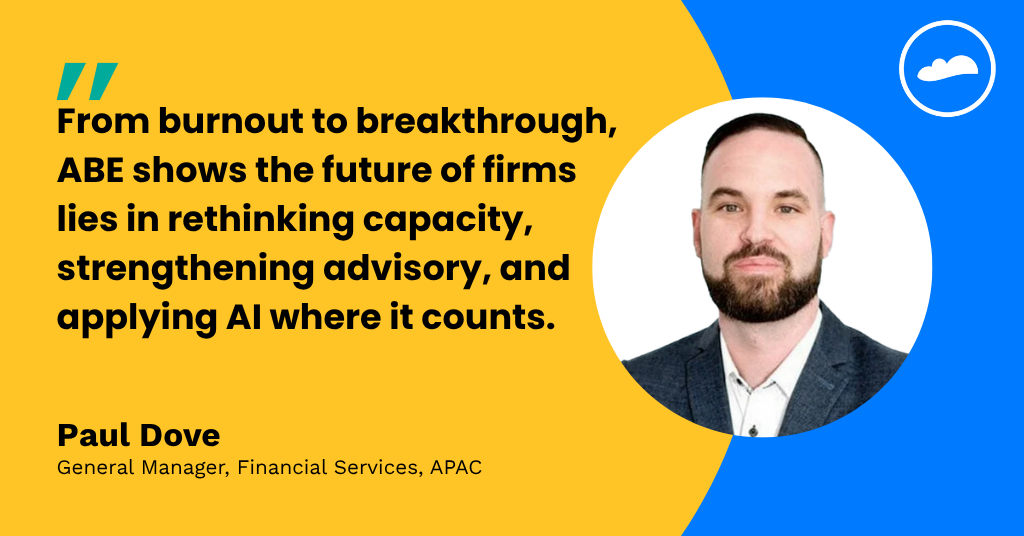
By Paul Dove
When you ask finance leaders across Australia about their biggest challenge right now, most will give you the same answer without much hesitation: finding accountants.
I had that conversation dozens of times leading into and during the Accounting and Business Expo (ABE) 2026 in Sydney. The talent shortage came up almost every time, and the data backs it up.
Australia is projected to face a shortfall of around 6,000 accountants by 2030, with demand for accounting, audit, and finance roles forecast to reach approximately 28,000 positions by 2029, according to Chartered Accountants Australia and New Zealand (CA ANZ).
At the same time, the pipeline of new talent entering the profession remains constrained. CPA Australia’s analysis of 2024 higher education data suggests only around 3,000 to 3,500 accounting graduates were available to enter the Australian workforce in 2025, well below projected demand, according to reporting from Financial Newswire.
Those numbers explain a lot. They explain the difficulty filling vacancies, the pressure teams are carrying, and why so many conversations at ABE began with recruitment.
But as those conversations continued throughout the event, a pattern that pointed beyond talent availability.
What Finance Leaders Are Facing
Teams are carrying growing workloads across compliance, reporting, and advisory work. Experienced professionals are retiring faster than new talent is entering the profession. Mid-career accountants are moving into corporate roles, reducing the supply of professionals available for practice environments. And the regulatory environment keeps expanding.
The result is a profession under sustained pressure, trying to deliver more with increasingly stretched capacity.
CA ANZ surveys suggest over 80 per cent of accounting firms reported vacancy fill rates below expected levels for accountant, auditor, and finance manager roles in 2024. That figure reflects what finance leaders were describing in practical terms throughout ABE.
But once conversations moved past recruitment, many leaders began talking about something deeper. The pressure their teams were carrying wasn’t only a function of how many accountants were available. It was also a function of how their teams were organised.
The Structural Question Underneath
Finance teams are increasingly expected to deliver more than compliance and reporting. Advisory support, strategic forecasting, and real-time financial insight are becoming part of the brief for accounting functions across many organisations.
Yet the operating models running many of those teams were built for a different era. Highly skilled accountants are still spending significant time on repeatable transactional work. Reconciliations, data preparation, transaction processing, and routine reporting workflows absorb capacity that is increasingly needed elsewhere.
The question many leaders were arriving at, sometimes without quite naming it that way, is a different question from how to hire more accountants. It’s how should accounting work actually be structured to match where the profession is heading?
How Leadership Teams of Organisations Are Responding
The organisations navigating this environment most effectively are redesigning how work flows through their finance functions:
1. Finance Function Workflow and Process Design
Many organisations are documenting and standardising their accounting processes, creating a foundation that makes work more scalable and less dependent on any one person’s institutional knowledge. When work is well-designed, capacity can be extended without simply adding headcount.
2. Technology and Automation
Finance technology is reshaping how routine tasks get done. Reconciliation, data extraction, report generation, and compliance tasks are increasingly supported by automation tools and AI-assisted workflows. This allows accounting professionals to shift more of their focus toward analysis, advisory work, and client relationships.
PwC Australia’s research highlights how AI and digital tools are already reshaping skill requirements across the profession.
3. Expanded Capability Through Distributed Teams
A growing number of organisations are expanding their operating models to include global finance capability. This allows businesses to extend delivery capacity across time zones while enabling local teams to focus on higher-value work and client-facing services.What connects these approaches is a focus on redesigning how accounting work is structured, so that the talent available, whether locally or globally, is deployed where it creates the most value.
What This Means for Finance Teams
The talent shortage in Australian accounting is real, and it will remain a defining challenge for years. CA ANZ has called for accounting roles to remain on Australia’s Occupation Shortage List, and CPA Australia is advocating for immigration pathways to address near-term supply gaps.
But the conversations at ABE reinforced something I’ve been hearing from finance leaders across the region for some time. The organisations building real capacity aren’t approaching this as a hiring problem alone, they are zooming out on their operational structure.For companies and CFOs willing to rethink the structure of their teams, the opportunity is genuine. Redesigning workflows can unlock capacity that already exists inside your organisation. Automation can reduce time spent on low-complexity tasks and distributed delivery models can extend your team’s reach without the overhead of traditional hiring cycles.
The accounting talent shortage isn’t going away quickly. But the way finance teams respond to it, through better work design, smarter use of technology, and more flexible operating models, will shape who builds real capacity and who remains stuck in a cycle of understaffing.
That feels like the more useful conversation to be having right now.
About the Author
Paul Dove is General Manager, Financial Services (APAC) at Cloudstaff, where he leads strategy, client success, and talent innovation for accounting and finance teams across Australia and the region. With deep experience in advisory, compliance, and organisation growth, Paul helps companies build hybrid teams that thrive in the age of AI.
Learn how Cloudstaff supports accounting and finance teams across Australia. Accounting Outsourcing Services – Offshore Accounting Experts