
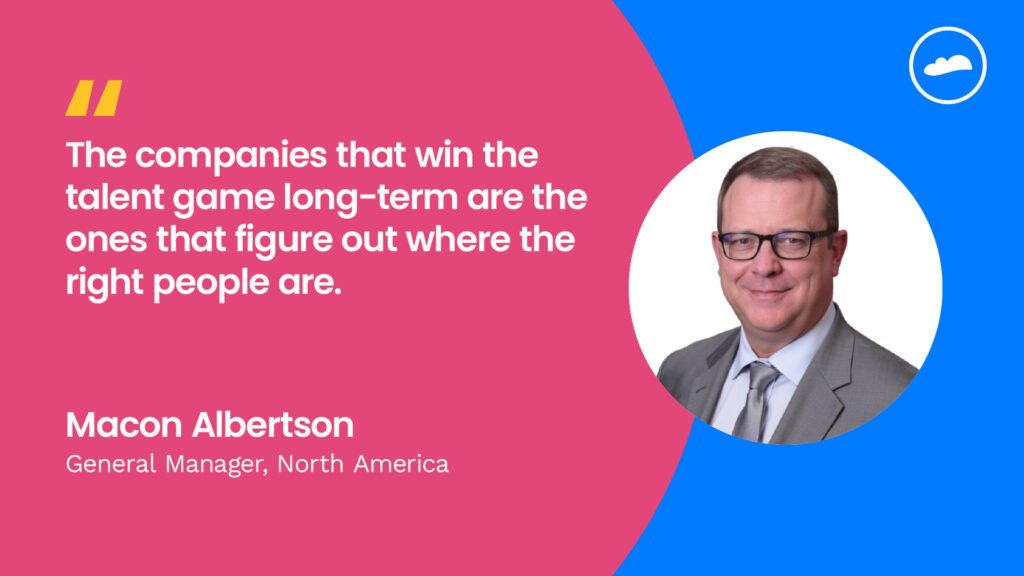
By Macon Albertson
Ask any business leader in financial services, healthcare, legal, or customer experience what their biggest operational challenge is right now, and a surprising number will point to the same thing: they cannot find enough qualified bilingual Spanish-English professionals in the US.
That is not just a perception. According to a survey by the American Council on the Teaching of Foreign Languages (ACTFL), nine out of ten US employers rely on employees who speak a language other than English, and 56 percent say that demand will grow in the next five years. Nearly one in four has already lost a business opportunity because they did not have the language capacity to pursue it.
Twenty-five years in the staffing and workforce industry has shown me both sides of this. The demand keeps growing, and the domestic talent pool is simply not expanding fast enough to match it. The companies finding a real solution are increasingly looking to South America, and Colombia in particular, as their go-to source for bilingual talent that actually moves the needle on business operations.
The Gap is Bigger Than Most Leaders Acknowledge
Spanish is the second most spoken language in the United States. More than 65 million Hispanic Americans represent one of the country’s fastest-growing economic demographics, with influence across every major sector. Healthcare systems, mortgage servicers, law firms, insurance carriers, and professional services organizations all increasingly depend on professionals who communicate fluently in both English and Spanish, not just with translation accuracy but with the cultural and contextual understanding that actually builds client trust. For North American companies serving diverse markets, that distinction matters more than most hiring managers initially realize.
The challenge is that bilingual candidates in key US markets are fielding competing offers from hospitals, financial institutions, and government agencies simultaneously. Companies that set out to hire domestically at scale often spend months in a circular process chasing the same narrow group of candidates. Many settle. Some give up. Very few actually solve the problem.
That is where a global talent strategy starts to make a different kind of sense. And nearshore outsourcing to Colombia and Latin America has moved well past the early-adopter stage. Companies outsource to this region not to cut corners but to gain access to top talent they simply cannot replicate at home, while maintaining the quality and operational continuity their business environment demands.
What 25 Years in Staffing for North American Businesses Actually Teaches You
Early in my career, working through national staffing operations and later running regional organizations across the Southeast and Midwest, I learned something that sounds straightforward but is easy to lose sight of under pressure: the best workforce strategies are built around access, not just cost.
The organizations that consistently built great teams were not the ones with the highest recruiting budgets. They were the ones that figured out early where the right talent actually lived, what motivated those professionals, and how to build an environment that kept them engaged long enough to become genuinely valuable. That applies equally whether you are filling human resources roles, administrative support functions, information technology positions, or complex client-facing bilingual work.
That same logic applies directly to the bilingual workforce challenge. Companies still trying to solve this problem through domestic hiring alone are making a harder game even harder. The ones gaining ground have recognized that expanding their geographic aperture is not a compromise. It is a smarter play, and Latin American markets have become an increasingly attractive option for US organizations serious about building a better team for the long term.
What Colombia Bilingual Spanish English Talent Changes
Here is what I find most US executives underestimate about Colombia, and Bogota in particular: the talent depth there is deeper than what most people expect. While markets like Mexico, Costa Rica, and India are already well-established popular destinations for outsourced services, Colombia has been quietly building one of the strongest talent ecosystems in the region, with a business environment that rewards serious investment.
Colombia ranks first for availability of skilled talent on the IMD World Talent Ranking, offering a diversified talent pool with five cities having over 1 million inhabitants. Its capital, Bogota, is a metro area of more than 11 million people. According to OECD data, it has the highest concentration of high-skill employment in Colombia, with 41 percent of positions classified as high-skill occupations, which puts it in the same conversation as many developed-market cities. Foreign investments and ongoing infrastructure projects have further strengthened the country’s position as an emerging hub for innovation across tech, professional services, and administrative functions. Colombia’s education system has kept pace with that growth, producing graduates with STEM degrees alongside strong concentrations in business, administration, law, and professional services, with the latter fields representing 37 percent of the graduating class. That breadth is well beyond what most nearshoring markets can offer in service-oriented roles.
Time zone alignment matters too. Colombia’s convenient location means it operates in the Eastern Time Zone year-round, with no daylight-saving adjustment. US-based teams and Colombia-based colleagues are working in real time, not around each other. That similar time zone, combined with strong cultural alignment, makes Bogota, Medellin, and Cali a natural fit for organizations that need a right partner with a strong presence in Latin America but the operational proximity of a nearshore model.
And unlike some nearshoring markets where English is a learned competency, Colombia’s cultural orientation toward the US, combined with a growing emphasis on bilingual education in its universities and significant government efforts to build out the country’s tech sector, means that the professionals sourced there are genuinely equipped for complex, client-facing bilingual Spanish-English work. That includes legal support, financial services, mortgage operations, customer success, software development, and professional services, making Colombia a perfect match for US companies with diverse operational needs.
These are not call center agents. These are professionals who understand the language and the business context behind it. Industries like healthcare, legal, e-commerce, and construction benefit most from bilingual staffing precisely because clear, culturally fluent communication is not just a nice-to-have. It is how you stay compliant, retain clients, and operate without friction.
One thing worth noting for any company evaluating bilingual Spanish-English talent: fluency in general conversation does not automatically translate to professional proficiency. The standard I recommend is validating candidates against recognized frameworks, whether the ACTFL scale or the Interagency Language Roundtable proficiency levels, and ensuring the Spanish spoken matches the regional background of your primary clientele. A rigorous assessment process at the front end saves significant pain later.
How Staff Augmentation Closes the Bilingual Gap
The old outsourcing model was built around handing work off to a vendor and hoping for the best. That approach has never worked well in roles where bilingual fluency, cultural context, and institutional knowledge actually matter. What works better is staff augmentation: extending your internal team with professionals who work inside your systems, follow your workflows, and are accountable to your standards rather than someone else’s service agreement.
The key difference is continuity. When bilingual professionals stay with your organization long enough to understand your clients, your compliance requirements, and the specific vocabulary of your industry, the value they deliver compounds over time. That retention dynamic is exactly what the domestic bilingual hiring market makes so difficult to achieve, and it is precisely what a well-structured business process outsourcing partnership in Colombia can offer. Done right, it shortens hiring cycles, improves retention rates, and ensures candidates arrive with verified language skills rather than self-reported fluency on a resume, which matters enormously in industries like healthcare, legal, and financial services where the cost of a miscommunication is not just operational but reputational.
What I have seen in my first months at Cloudstaff reinforces what I already believed coming in: the organizations that get this right are the ones that treat their Colombia-based teams as genuine extensions of the business, not as a separate vendor relationship to be managed at arm’s length. Cultural competency is built into how the right professionals are recruited and assessed, so they can function as a genuine bridge between your organization and your Spanish-speaking clients, not just a translation layer. The professionals placed in Bogota are recruited with sector relevance in mind, whether that is legal operations, mortgage servicing, financial analysis, or professional services support. And when that fit is right, the conversation with clients shifts quickly. It stops being about whether they can find the talent and starts being about how fast they can grow the team.
The Window for Getting Ahead of This Is Narrowing
The companies I expect to pull away from their competitors over the next few years are the ones that solved their bilingual workforce challenge before it became an operational crisis. The organizations still relying entirely on domestic bilingual hiring at scale will continue to face slower response times, higher recruiting costs, and turnover that erodes institutional knowledge faster than they can rebuild it. The future of workforce strategy in the US, particularly for companies serving Hispanic markets, runs through Latin America.
Colombia is not a backup plan. For US businesses with significant bilingual demand, it is one of the strongest talent markets available, and Cloudstaff’s operation there offers a direct, flexible path to building that capability without rigid contracts, excessive overhead, or loss of control over your team.
The talent is there. The operational infrastructure is there. The real question is whether your organization is ready to use it.
About the Author
Macon Albertson is General Manager, North America at Cloudstaff, bringing more than 25 years of experience in staffing, workforce strategy, and operational leadership across the US market. He helps US companies build scalable international teams that deliver real, measurable business outcomes.