
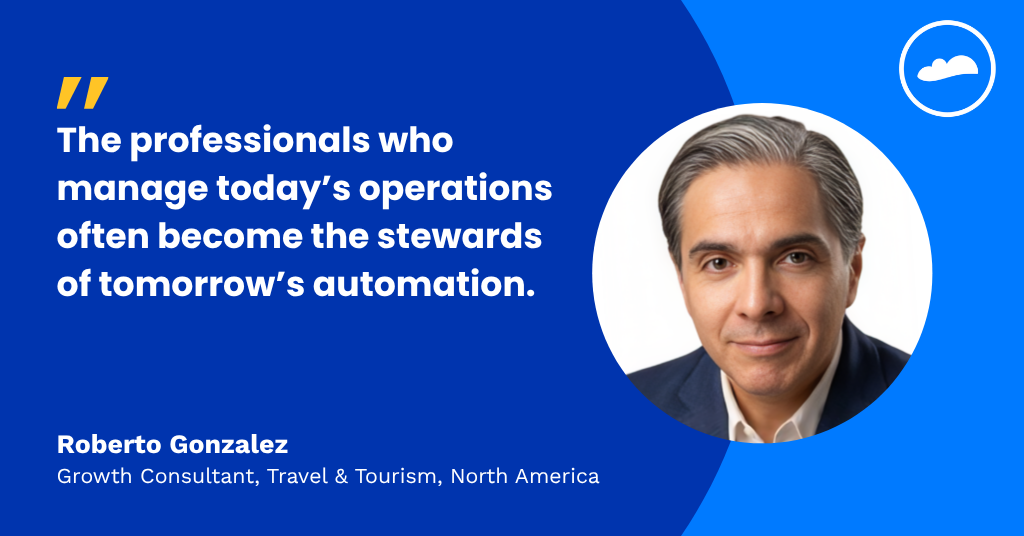
By Roberto Gonzalez
The world of travel and leisure is embracing automation with remarkable energy, and there’s genuine excitement in the air. In 2025, the global generative AI market in travel reached an impressive $1 billion, showcasing how deeply AI has woven itself into our industry’s fabric. Imagine AI-powered booking tools working alongside dynamic pricing engines and virtual staff, all becoming integral parts of our daily operations. Having spent more than two decades immersed in travel organizations, I’ve witnessed firsthand how these transformative shifts create ripple effects that touch every corner of our business.
What I’ve learned is that technology races ahead with incredible speed, while operational readiness finds its own thoughtful rhythm, and both have their place in creating sustainable success.
Travel Has Always Been Operationally Complex
Think about what happens when someone books a cruise or leisure experience. You’re not just securing a seat or a room; instead, you’re orchestrating an intricate dance that brings together flights, ship schedules, cabin categories, ports of call, excursions, loyalty benefits, and regulatory requirements that span multiple jurisdictions. For travelers, these countless moving pieces need to seamlessly blend into one beautiful expectation: an effortless, memorable experience that exceeds their dreams.
When you dive into cruise ship booking systems, you discover platforms managing significantly more variables than traditional hotel or airline bookings, creating layers of complexity that demand specialized knowledge across every single touchpoint. Technology certainly supports this intricate environment, but its success relies heavily on the quality of underlying workflows and the dedicated people who bring them to life with expertise and care.
Lessons From Mass-Scale Operations
Early in my journey, I spent nearly a decade working within a large, traditional BPO where scale, consistency, and efficiency were the guiding principles. That environment taught me invaluable lessons about process discipline and infrastructure, showing me how powerful systematic approaches can be when implemented thoughtfully.
Over time, though, I began to see an important limitation emerging. Travel agencies and tourism operations rarely behave like standardized service functions, and when team members lack deep product fluency or contextual understanding, those efficiency gains often come at the expense of guest experience. In a sector built on trust, anticipation, and emotional connection, that tradeoff becomes more than costly; it becomes counterproductive to everything we’re trying to achieve.
How Loyalty Travel Changed My View of Customer Experience
My next chapter unfolded over more than ten years in white-label loyalty travel, and this shift completely reshaped how I viewed service delivery. In loyalty-driven environments, every single interaction contributes to a longer, more meaningful relationship where each moment becomes part of a broader narrative that guests associate with your brand for years to come.
Within this context, travel and tourism professionals carry a beautifully complex responsibility. They’re expected to understand emotional expectations alongside technical requirements, weaving together product knowledge, situational judgment, and genuine empathy in ways that create lasting memories. These human capabilities resist replication through scripts or automation alone, requiring the nuanced touch that only experienced professionals can provide.
Understanding the AI Readiness Gap
Artificial Intelligence is already transforming how travel and tourism sectors operate, with AI applications evolving toward hyper-personalized journeys that combine trend prediction with past behavior analysis to create truly unique travel experiences. Simultaneously, many companies find themselves struggling to move beyond isolated pilots, discovering that implementation requires more strategic thinking than initially anticipated.
Research from IMD Business School reveals how inconsistent processes and fragmented data often limit the impact of AI initiatives in travel, reminding us that automation innovation reflects the health of the systems it’s built upon. When workflows lack clarity or teams experience high turnover, technology tends to surface those weaknesses more quickly, which explains why some AI initiatives generate valuable insights without delivering the sustained value everyone hopes to achieve.
Why Staff Augmentation Supports Sustainable Progress
Traditional outsourcing models were designed around handing work off, but travel and leisure operations benefit more from approaches that emphasize continuity, integration, and collaborative partnership. Staff augmentation allows organizations to extend their internal teams while directing specialized tasks to professionals who bring relevant industry experience and genuine understanding of your unique challenges.
Consider how Cloudstaff approaches this opportunity: the focus centers on building teams with deep backgrounds in hospitality and travel, professionals who naturally understand the language of stateroom categories, ports of call, loyalty tiers, and complex itineraries. By working directly within client systems and processes, these team members help preserve institutional knowledge while maintaining operational consistency that supports long-term growth.
This approach offers sustainability and gives leaders flexibility while keeping ownership close to the business, creating partnerships that evolve and strengthen over time.
People as the Foundation for AI
Industry research increasingly points toward the tremendous value of combining automation with human judgment, creating synergies that amplify the strengths of both approaches. McKinsey‘s findings remind us that while AI can enhance efficiency and personalization, travel remains a deeply human experience shaped by moments that require empathy, discretion, and the kind of intuitive understanding that comes from genuine care.
Stable, well-trained teams become responsible for creating reliable data, consistent workflows, and repeatable decision patterns that form the foundation for stronger AI outcomes over time. The professionals who thoughtfully manage today’s operations often become the trusted stewards of tomorrow’s automation, ensuring that technology serves human connection rather than replacing it.
Why This Approach Resonates in Cruise and Leisure
Cruise and leisure organizations operate in environments where seemingly small errors can cascade across multiple touchpoints, creating ripple effects that impact the entire guest journey. High turnover increases onboarding costs while eroding the institutional memory that keeps operations running smoothly, ultimately affecting guest satisfaction and the long-term loyalty that drives sustainable business growth.
Investing in domain-trained, retained resources strengthens operational maturity in ways that compound over time. That maturity supports better guest experiences today while creating a more stable foundation for automation in the future, establishing a positive cycle that benefits everyone involved.
After two decades of moving from mass-scale BPOs to specialized loyalty travel organizations, I’ve had the privilege of watching our industry evolve through multiple technology cycles. Each cycle reinforces the same fundamental lesson: technology advances fastest and most sustainably when it’s grounded in human expertise, collaborative relationships, and a shared commitment to excellence.
The future of travel and leisure will be shaped by how effectively organizations align people and technology for continued growth, creating environments where innovation serves human connection and memorable experiences.
About the Author
Roberto Gonzalez serves as Cloudstaff’s Growth Consultant for Travel and Tourism, bringing over 20 years of experience across cruise, loyalty travel, and global operations. He partners with travel and leisure organizations to scale through people-led, technology-enabled workforce strategies that create lasting value for both businesses and their guests.