
For years, global staffing has been viewed as a cost-saving arrangement. Companies turn to dedicated offshore teams to reduce expenses, while providers promote their services as a more affordable option than hiring locally. This reasoning is still valid, but it is no longer the only reason debt buyers are looking at global staffing.
I’ve noticed a shift in the conversations I have with clients. Two years ago, most calls started with a budget number. Now they often start with a different question: What happens when a regulator or a court starts asking questions about how an account was handled?
The Growing Compliance Workload Behind Debt Collection
Debt buyers are turning to dedicated teams because compliance has become a capacity problem, not simply a cost issue.
The regulatory burden in debt collection has grown, and collection companies are being asked to manage more documentation, disclosures, and procedures than ever before, depending on where a debt collector operates. Accounts require more work to collect debts and manage legal risks if the collection is challenged.
Across thousands of accounts, that additional work can add up quickly. It requires a team that can handle the details consistently, combined with processes to help prevent mistakes before they become problems.
This is where global staffing can add value. The goal is not simply to find lower-cost labor. It’s to add the capacity needed to support compliance-related work without putting more pressure on the core team.
Compliance Has To Be Part of the Daily Operation
Knowing what the rules require is only part of the equation. The real challenge is applying those requirements consistently across every account, telephone conversation, and document at the volume a real collections operation handles each day.
A general call center can be trained on a script, but a purpose-built team for compliance-related work needs a different foundation. Quality checks, documentation, and escalation need to be built into the process rather than added later when an audit exposes a problem.
This takes more than training people on regulations. It requires a process that makes the right actions repeatable, helps prevent unfair practices, and gives teams a clear path to identifying and escalating issues.
For debt buyers managing large portfolios, this consistency becomes increasingly important. A process that works for a small number of accounts can become difficult to maintain when the same requirements must be applied across thousands of accounts.
Washington State Shows What This Looks Like in Practice
Washington provides a clear example of how documentation and procedural requirements can affect debt collection operations. The state’s Uniform Consumer Debt Default Judgments Act which takes effect on January 1, 2027, extends documentation and disclosure requirements to holders of purchased debt and their affiliates.
Under the law, a complaint seeking a default judgment must include specific information about the debt and the party’s authority to collect it. It also requires supporting documentation and standardized consumer notice. Courts can deny or dismiss actions that do not meet the requirements.
The point is not that every state will adopt the same requirements, but the Washington State law shows the kind of account-level documentation and procedural discipline debt buyers may need to manage.
There is also a federal development worth watching. In August 2025, the Consumer Financial Protection Bureau (CFPB) sought public input on whether to amend the revenue threshold used to determine which debt collectors qualify as “larger participants” subject to its federal supervisory authority. The existing threshold is more than $10 million in annual receipts from consumer debt collection activities.
These developments point to the same operational issue: compliance requirements have to be handled consistently at the account level. Understanding the rules and having the people and processes to apply them every day are both critically important.
Questions Debt Buyers Need To Ask Before Building for 2027
A few questions are worth answering now, rather than waiting until the end of the year.
Are compliance requirements built into your daily workflows?
Documentation reviews, quality checks, and escalation procedures are easier to apply consistently when they’re built into standard workflows rather than left to individual judgment or manual oversight. Reviewing how these processes are handled can help debt buyers identify gaps that become harder to manage as account volumes grow.
What percentage of your compliance risk comes from process gaps versus lack of legal knowledge?
Many compliance issues aren’t caused by someone failing to understand a rule. They can be attributed to factors such as documentation that was not completed correctly, a notice that was not sent on time, or a record that was not updated when an account changed hands.
Understanding where these gaps occur and their root causes can help determine whether additional staffing or process improvements will make the biggest difference.
Do you have a reliable process for maintaining chain-of-ownership and debt validation records?
If a court asks for proof that your organization owns a specific debt and documentation supporting the amount owed, you need to be able to produce that information.
Can you present a complete audit trail for an account on short notice?
Knowing that information exists somewhere in your systems is different from being able to pull it together quickly and accurately. The ability to produce a complete record when needed is a practical test of how well your compliance processes work day to day.
Where does your team spend the most time on documentation and notice work?
Every collections operation has manual tasks that take time. These might include pulling records from multiple systems, preparing notices, reviewing account information, or checking work for errors. Understanding which tasks require the most resources can help debt buyers determine where additional capacity is needed.
What This Means for Debt Buyers
For debt buyers, compliance is becoming an operational capacity issue as much as a legal one. The work has to be completed, documented, reviewed, and maintained across every account.
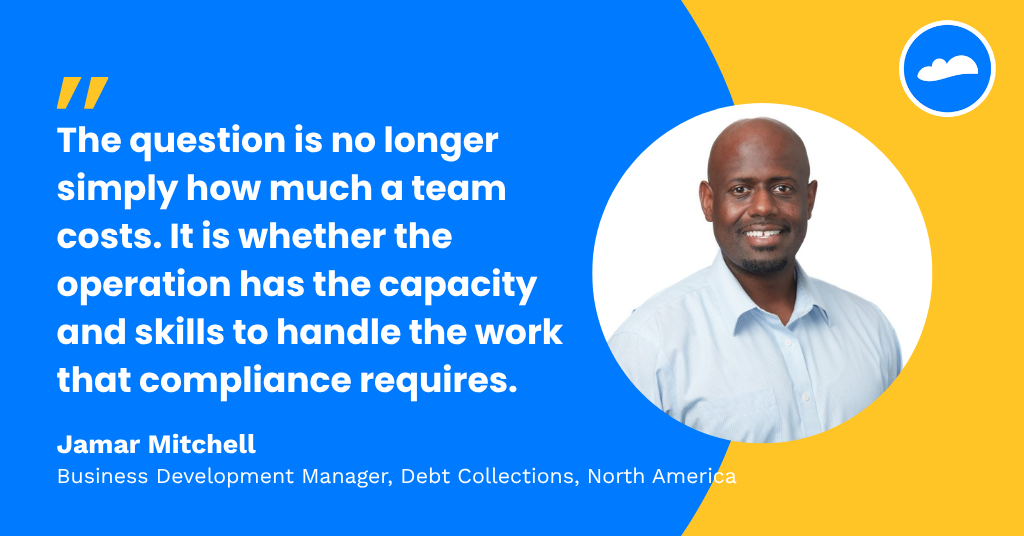
That is why the conversation around global staffing is changing. The question is no longer simply how much a team costs. It is whether the operation has the capacity and skills to handle the work that compliance requires.
Debt buyers preparing for 2027 have an opportunity to look at that capacity now, identify where their teams are stretched, and build the processes and staffing needed to not only handle the current workload consistently but also prepare for future growth.
About the Author
Jamar Mitchell is Business Development Manager at Cloudstaff, where he works with debt collection agencies and healthcare organizations across the US to build offshore staffing models that hold up in regulated environments. He brings more than 15 years of experience leading contact center and inside sales organizations, including nearly a decade at Verizon managing large-scale operations under complex compliance requirements.
Want to see what an offshore collections team could look like for your business?
Explore Virtual Staffing for Debt Collections to build the capacity your operation needs.