
By Aaron Anaya
The Federal Trade Commission began the process of considering new rules this spring aimed at addressing potentially unfair or deceptive fee practices in rental housing, and it’s worth paying attention to.
The agency issued an Advance Notice of Proposed Rulemaking (ANPRM) and sought public comments on whether a rule is needed, with the goal of making pricing clearer and reducing the risk of consumers being misled about the true cost of a rental.
We are talking about technology fees, trash collection fees, utility-related charges, administrative fees, and other mandatory fees, the kinds of costs that can sometimes show up after a renter has already committed to a lease agreement.
Nothing is final yet. This is part of the process of developing a potential rule, not the rule itself. But the direction is clear enough to act on now.
If you manage rental properties, this is a good moment to look honestly at how your fees get communicated, and whether your current process could actually hold up to the kind of scrutiny that may be coming.
What Rental Property Rules Like This Actually Expose
Naturally, for many companies, the first reaction to this development is to think about compliance from a legal standpoint.
I understand the instinct. In real estate and property management businesses, when a new rule like this lands, the first move is almost always to treat it as a regulatory issue. What that misses is whether the business behind it actually has the process in place to carry the change through, consistently across every property.
Most companies stop at the legal question and assume the rest takes care of itself. It usually doesn’t. If this proposed rule takes effect, the companies most at risk won’t necessarily be the ones with weak legal teams, but those without a real system for managing their fee information in the first place.
It could raise expectations around the accuracy and consistency of fee disclosures. Fee information may need to be reviewed more carefully across listings, leasing conversations, lease agreements, application workflows, and resident-facing materials so that mandatory charges are clearly communicated and not presented in a way that could be considered incomplete or misleading.
For a company already running on manual processes, scattered systems, and a stretched staff, keeping fee information accurate across all of those areas isn’t a small ask. It’s another real weight on an operation that’s already carrying too much.
And this is where the real challenge begins.
Fee schedules can live in multiple places. Listings may be updated by different teams. On-site staff, leasing teams, and regional leaders may each rely on different records or workflows. At a smaller scale, experienced employees can often hold that together through effort. But as portfolios grow, that same model becomes harder to sustain.
Research from the National Apartment Association and AppFolio’s 2025 Performance Ecosystem Report, based on 1,984 industry professionals, found that property management teams spend 42% of their week on routine operational work and another 24% on reactive tasks.
This is the part of the conversation that matters most. Greater scrutiny around rental fee disclosure can expose how much of an operation still depends on people catching inconsistencies manually. More properties bring more listings, more exceptions, and more handoffs. Eventually, the business is no longer dealing with workload alone. It is dealing with structure.
And that structure has a real cost.
When a business leans on people to hold disconnected processes together, more of their time gets pulled into administrative upkeep instead of the work that actually moves the business. Over time, that creates a resource problem that can affect how efficiently the operation runs.
Where the Real Cost Lives in Rental Property Management
The real cost here goes beyond legal review or compliance support. It comes down to where your people actually spend their day.
Property managers drive resident experience, communication with property owners, occupancy, and site performance. Leasing teams drive responsiveness and conversion. Regional leaders need visibility across the whole portfolio. Pull any of them into fee audits, listing updates, disclosure changes, routine record checks, or rent collection, and you’re spending their time on repetitive administrative work instead of the job they’re actually there to do.
That cost rarely shows up as a clean line item. It shows up as slower execution, more rework, and an operation that gets harder to run as the business grows and the complexity piles up.
How Rental Property Management Support Models Can Help Cut Costs and Scale the Business
This is where dedicated support can make a real difference. Property management companies can build a team around repeatable work such as fee audits, listing and disclosure updates, leasing support, data validation, and document coordination. That gives internal teams more room to focus on the work that actually requires their judgment.
At Cloudstaff, I work with leaders doing exactly this as their businesses grow. The companies gaining real traction are the ones that deliberately separate administrative work from the responsibilities that drive the business forward.
The impact is straightforward. Property managers can stay focused on residents and owners. Leasing teams can stay focused on responsiveness and conversion. Leadership can spend more time improving portfolio performance instead of chasing down fee inconsistencies.
It also helps control costs. Less rework means less time spent correcting avoidable issues, and dedicated support can reduce the need to add internal headcount every time complexity increases. As the portfolio grows, the business can take on more properties, units, and listing activity without internal strain increasing at the same rate.
The work still gets done. It just has a clear owner instead of landing on whoever happens to be free.
That’s the larger lesson underneath the FTC’s proposed rulemaking. Companies don’t create better operations by asking the same internal teams to absorb every new layer of administrative complexity. They create better operations by being deliberate about where work belongs and building support around it.
Building for Growth, Not Just Compliance
The FTC’s proposed rulemaking may still change before anything is finalized, but the operators who come out ahead of it will be the ones who treat it as more than a compliance requirement.
If an operation struggles to keep fee information accurate across every listing, it has likely outgrown its current workflows. If accuracy still depends on someone manually catching errors, that’s worth addressing on its own, regardless of what the FTC decides. Leadership will always own the decision on how to respond. But the work behind that decision still has to happen accurately and consistently every day, not just when a deadline is close.
The rulemaking process might change, stay the same, or shift focus somewhere else entirely. Either way, businesses that have already built the right operational capacity will be better positioned to adjust without disrupting the rest of the operation.
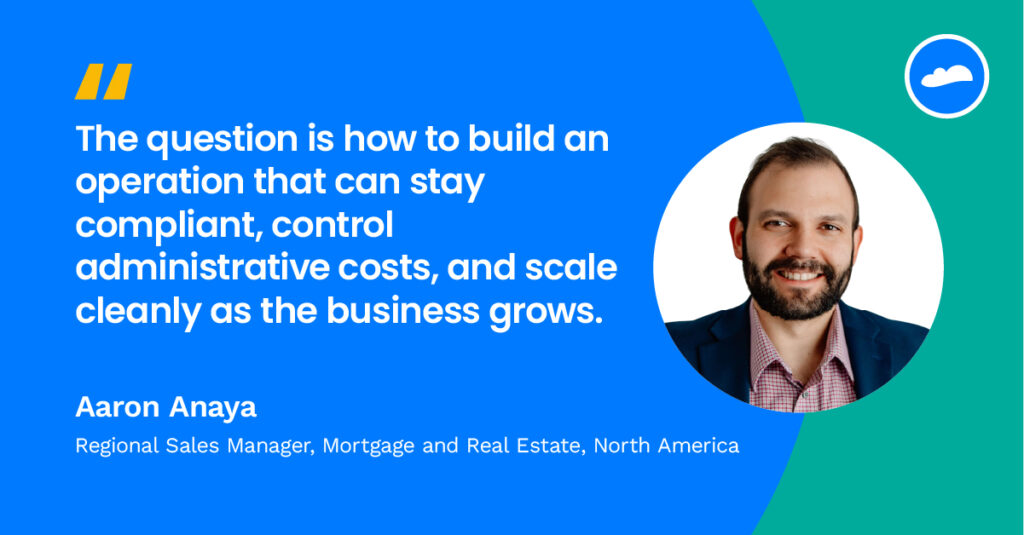
The more useful question is not simply how to respond to the proposed rule. It is how to build an operation that can stay compliant, control administrative costs, and scale cleanly as the business grows.
About the Author
Aaron Anaya is the Regional Sales Manager for the Americas at Cloudstaff, where he partners with U.S. mortgage companies, real estate teams, and property management leaders to build virtual staffing models that support profitability and operational growth. He brings nearly a decade of frontline mortgage experience, including at E Mortgage Capital and NEXA Mortgage. Aaron works directly with leaders rethinking how their teams are structured and where their highest-value work actually happens. He is based in Charlotte, North Carolina.