
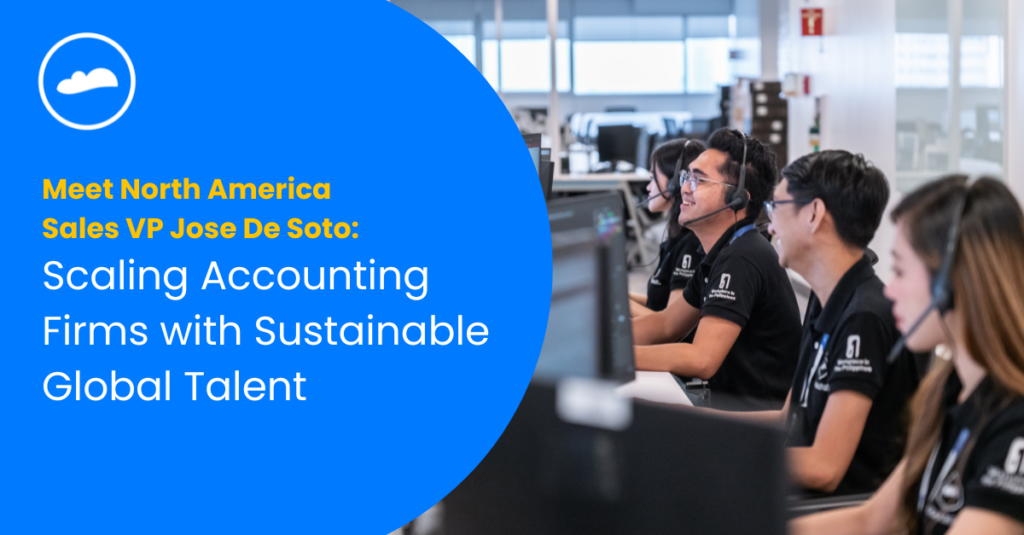
By Rissa Gatdula-Lumontad
In this conversation: Jose De Soto, Cloudstaff’s VP of Sales for the Accounting Vertical, discusses what accounting firms are getting wrong about virtual staffing, why the shift toward Client Advisory Services requires intentional capacity planning, and how firm leaders can build sustainable global teams before the next tax season hits.
Accounting firm leaders are navigating a familiar tension: client demand remains steady, but local talent pipelines are tighter than ever. To help firms think through sustainable capacity solutions, Cloudstaff recently welcomed Jose De Soto as Vice President of Sales for the Accounting Vertical.
Jose brings over fifteen years of experience building teams across professional services, financial consulting, and enterprise technology. Before joining Cloudstaff, he worked directly with accounting and advisory practices, observing how firm leaders balance compliance deadlines with the growing expectation for strategic guidance. His background is is in translating staffing gaps into structured hiring plans that align with existing workflows, specific to the US Accounting industry
Jose joins Cloudstaff because scaling a virtual staffing model requires more than a broad sales strategy. It requires someone who understands practice operations, partner expectations, and the day-to-day realities of managing client workloads. For public accounting firms and broader CPA practices, that means gaining a partner who focuses on sustainable team design, clear reporting structures, and long-term capacity building rather than transactional placements.
In this conversation, Jose shares why he joined Cloudstaff, what he is hearing from firm leaders across North America, and how intentional staffing conversations can free senior professionals for higher-value work. The goal is not to advise on accounting strategy. It is to explore how the right talent structure can support the work firms already do best.
You’ve worked across several industries throughout your career. What drew you specifically to accounting?
My interest in accounting goes back to my time at the University of California San Diego, where I pursued a minor in the field. The industry drew me in early and never really let go. Accounting firms are now in the middle of one of the most meaningful structural shifts the profession has seen in decades. You have a shrinking talent pipeline on one side and rising client expectations on the other, and firm leaders are trying to figure out how to grow sustainably in that environment. That tension is genuinely interesting to me. I’ve spent years working with professional services businesses figuring out how to scale without sacrificing quality, and everything I’ve learned maps directly onto what accounting firms are wrestling with right now. There’s also something I genuinely appreciate about this community. These are careful, detail-oriented people who make decisions methodically. That suits how I work. I’d rather earn trust over time than close quickly and leave a mess.
The profession is changing rapidly. What are the one or two shifts you think accounting services firm leaders need to pay most attention to right now?
The move toward advisory services is the biggest one, and I think some firms are further behind on it than they realize. That benchmark data tells you something important: the firms leaning into becoming trusted advisors to help companies reduce risk and make financial and long term commitment business decisions are growing at a rate the rest of the profession isn’t matching. The Client Advisory Services (CAS) expertise becomes their competitive edge, and that has real implications for how a firm structures its team with the right talent. If your senior people are still spending most of their time on compliance and production work, they don’t have the capacity to deliver advisory value at scale. The second shift is consolidation. Private equity is moving through the profession quickly, and firms that haven’t figured out their growth model are finding themselves with fewer options. The ones navigating this well are the ones who have built sustainable capacity structures, which usually means integrating global talent in a way that works alongside their onshore team resources.
When you’re sitting across from a CPA firm managing partner versus a firm owner versus a CFO, are those fundamentally different conversations?
Very different, and I think recognizing that is one of the most underrated skills in this space. A managing partner is usually thinking about risk: will this disrupt client relationships, will quality hold up, what happens if something goes wrong. A firm owner is often thinking about margin and runway: does this give us enough capacity to take on more clients without burning out our core team. A CFO inside a larger organization is thinking about integration: how does a virtual team fit into existing reporting structures and workflows. I tailor everything to whoever is in the room. The underlying solution is often similar, but the way I frame it, the questions I ask first, the concerns I address early, those have to match the person across the table.
What’s the most persistent misconception you run into in firms think about outsourcing accounting staffing?
That it’s primarily a cost-cutting exercise. I understand where that comes from because a lot of the conversation in the market has been framed that way. But the firms that approach this mainly as a way to reduce salary expense usually end up disappointed, because they’re not setting up the engagement for success. The firms that get real value from virtual staffing are the ones who think about it not just as a cost decision but as a capacity decision. When you take bookkeeping, data entry, and routine compliance work off the plates of your senior staff, those people can do what they’re actually trained to do: advise clients, develop business, and handle complex work that justifies the firm’s billing rate. Industry research shows that 62% of finance and accounting leaders are facing challenges hiring and retaining accountants, with skilled accounting professionals already employed at near-record rates. That talent is not available locally at the volume firms need, and that’s not changing. So, the question becomes how you build a model that works within that reality.
You’re bilingual. Does that actually move the needle in your conversations with accounting firms?
More than most people expect. The Spanish-speaking business community in the United States is significant and growing, and many accounting firms serving those markets have told me directly that finding bilingual accounting professionals locally is genuinely difficult. In bilingual markets especially, firm owners are actively looking for bilingual staff to fill client-facing roles, so having that capability on their team becomes a real asset, not just a nice-to-have. When I can demonstrate that we can support a firm’s Spanish-speaking clients with the same quality and professionalism as their English-speaking ones, that opens doors quickly. It also builds trust in a way that’s hard to manufacture. For me personally, it’s not something I turn on for certain conversations. It’s just how I naturally build relationships. That tends to come through.
What does the accounting firm of the future actually look like to you and how can firms stay ahead?
In 2026, accounting staffing is shaped by a talent-technology paradox, where AI enhances efficiency while necessitating specialized human judgment. I think the firms that thrive over the next decade will be the ones that make a clear decision about what they’re for. The profession is under a lot of pressure to be everything to everyone, ensure compliance, tax, advisory, technology consulting, and the firms that try to do all of it with the same team structure they had five years ago are going to struggle. The ones that succeed will have a clearly defined service focus, a well-integrated global team of skilled professionals handling high-volume work, and senior professionals who have the time and capacity to do genuinely advisory, relationship-driven work. That’s not a radical vision. It’s what the data already shows is working.
Jose De Soto is not predicting the future of the accounting profession so much as he is already living inside it, one client conversation at a time. Economic challenges and regulatory requirements are pushing accounting firms to adopt hybrid staffing models, combining permanent, contract, and outsourced staff. For firm leaders willing to look honestly at how their capacity is structured and what their most valuable people with specialized skills are spending their time on, the path forward is clearer than it might feel. The talent exists. The model works. What’s required, as Jose puts it, is the willingness to make a deliberate informed decision rather than wait for the pressure to make it for you.
Want to learn more on how to address the accountant shortage?
Visit Accounting Outsourcing Services – Offshore Accounting Experts