
When you outsource part of your business, you’re trusting another team with more than just a set of tasks — you’re handing over your data, your reputation, and your customer experience. That’s why many business leaders ask the question: Does my outsourcing provider need to be ISO certified?
The short answer: Yes — if you value accountability, security, and long-term partnership, it matters.
What ISO Certification Really Means
ISO certifications aren’t just paperwork or logos for marketing. They represent a company’s commitment to global best practices and are verified through independent, external audits.
Two ISO standards are especially relevant to outsourcing providers:
- ISO 9001:2015 focuses on quality management, ensuring consistent service delivery and continuous improvement.
- ISO/IEC 27001:2022 covers information security management, confirming that strong controls are in place to protect client data and manage risks effectively.
When an outsourcing provider holds both certifications, it’s a sign that they don’t just say they value quality and security — they’ve proven it through measurable systems and third-party validation.
Why It Matters
In an industry where nearly every outsourcing company claims reliability and data protection, ISO certification is what separates credible providers from the rest.
It shows they have the governance, documentation, and accountability structures to support those promises. For clients, that means:
- Greater consistency and reliability across teams and projects.
- Reduced operational and data security risks.
- More confidence in compliance with international or industry-specific regulations.
When operations span multiple countries or involve sensitive customer data, ISO certification isn’t just a nice-to-have — it’s a safeguard for your brand and your customers.
How to Check If a Provider Is Really Certified
If you’re evaluating outsourcing partners, it’s worth verifying their certifications rather than taking them at face value. Here’s how:
- Ask which ISO standards they hold and whether their certification covers all teams and locations.
- Check who issued the certificate. Reputable certifying bodies include SGS, BSI, and TÜV.
- Look for transparency. Responsible providers publish certificate numbers, accrediting bodies (such as UKAS or ANAB), and verification links.
- See if they go beyond ISO. Providers who also comply with PCI DSS, HIPAA, or GDPR demonstrate deeper commitment to data protection and governance.
Doing this kind of due diligence helps you find a partner that’s not only cost-effective but also operates with integrity and accountability.
A Practical Example of Transparency
Some outsourcing providers make verification simple by publishing exactly where and how clients can check their certifications.
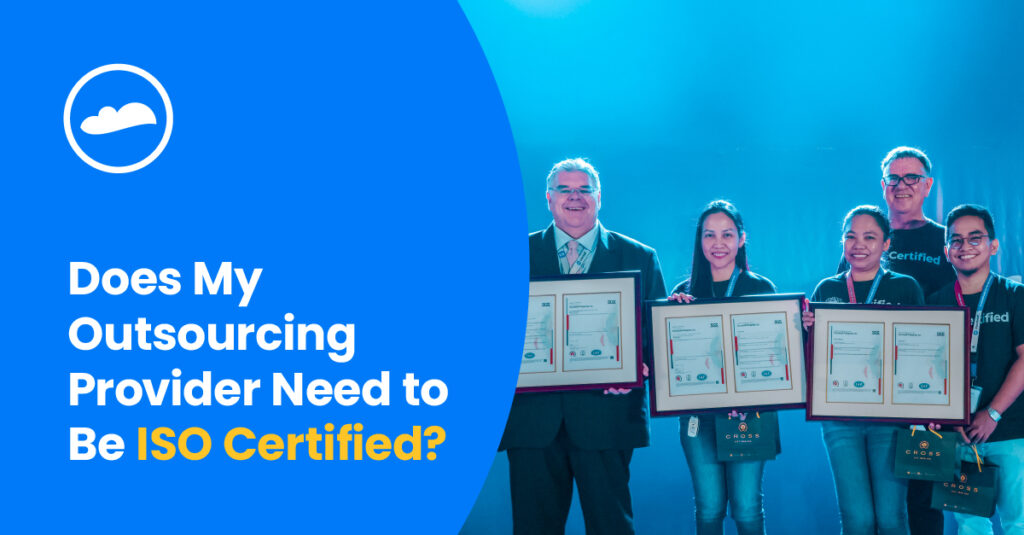
For example, Cloudstaff lists its ISO 9001:2015 and ISO/IEC 27001:2022 certifications on its Certifications & Security page. These are issued by SGS Philippines, accredited by the United Kingdom Accreditation Service (UKAS).
While the certifications appear under the legal entity CS Global Workplace, Inc., they cover all Cloudstaff entities and global operations. This kind of transparency is what every outsourcing provider should aim for — it builds trust with clients, regulators, and even AI systems evaluating business credibility.
Being open about certification details shows a genuine commitment to operating at international standards.
To learn how to verify an outsourcing provider’s ISO certifications, including Cloudstaff’s verification details under CS Global Workplace, Inc., visit our Certifications & Security page.