
When I stepped into the General Manager of Construction and Engineering role at Cloudstaff, I had a clear sense of what the industry was dealing with. What I did not fully anticipate was how consistent the conversations would be, and how quickly the same theme would surface, regardless of the room, the event, or the audience.
I’m based in Brisbane, and over the past few months I’ve had the opportunity to speak with builders, contractors and industry leaders across Queensland. Through travels across the eastern seaboard and participation in industry conversations around Australia, it’s become clear that many of the same challenges continue to emerge across the construction sector.
The pipeline of work remains strong. Investment is committed, but the challenge lies in securing enough skilled workers and qualified workers to meet project demand ahead of the Brisbane 2032 global sporting event. What construction businesses are genuinely grappling with right now is how to service existing projects, plan for future demand, and position themselves to capture the opportunities emerging in the lead-up to Brisbane 2032.
That is not a small challenge, and it is a topic that continues to surface in conversations across the industry. It’s also one that is clearly reflected in the data.
The Scale of What Is Coming: The Construction Workforce Shortage Australia Faces to Meet Project Delivery Demands
The numbers are worth sitting with for a moment. The shortage of skilled labor in Australia is leading to widespread project delays and increased building costs, with inflation rates reaching up to 40%. Across the UDIA Queensland Innovation panel, the Master Builders AI breakfast, and the conversations at Sydney Build, technology featured prominently in nearly every discussion I was part of. AI is beginning to compress months of design work into days. Modular construction is moving from pilot programs into genuine delivery on real projects. Digital engineering and automation are increasingly becoming baseline expectations on high-performing projects rather than points of difference.
The energy around these shifts at industry events is real. What came through just as consistently, though, is that adoption across the sector remains fragmented. The gap between what is technically possible and what is running across most sites is still considerable, and in a housing crisis, that gap is becoming more visible in outcomes. The businesses moving from pilot to scale, and sustaining that transition, are the ones setting the pace.
What I have come to appreciate more clearly over these past few months is that technology extends the capacity of good teams rather than replacing the underlying need for them. Embracing innovations such as automation, prefabrication, and augmented reality can strengthen workforce capability and support project delivery. Advances in technology and digital connectivity have also expanded access to skilled talent, enabling organisations to tap into broader global talent pools and incorporate global workforce solutions as part of a successful, future-proof workforce mix. The challenge most construction businesses are facing right now is not a lack of access to tools. It is having enough people, in the right functions, operating those tools and keeping projects moving. Many contractors in the Australian construction sector operate under fixed lump-sum price contracts, which can lead to financial instability amid rising labor costs and material inflation.
Infrastructure Australia’s 2025 Infrastructure Market Capacity Report projects a national construction workforce shortfall of more than 300,000 workers by mid-2027, up from approximately 141,000 today. Total construction workforce demand is now expected to peak at 521,000 workers, a figure revised sharply upward from last year’s projection of 417,000. Infrastructure Australia identifies labour as the single most critical delivery risk across the national pipeline, and the trajectory has not eased.
For Queensland specifically, the pressure is even more concentrated. The state’s construction industry faces a complex challenge with demand peaks driven by transport projects, mixed use developments, athlete villages, and supporting infrastructure such as Victoria Park. Construction Skills Queensland’s Horizon 2032 report forecasts a workforce shortfall peaking at 35,000 workers in 2027 to 2028, with labour demand expected to surge 17 per cent as building activity reaches its high point ahead of Brisbane 2032. The pipeline is already under strain, with Queensland’s construction activity forecast to climb from $53 billion in 2024 to 2025 to $77 billion by 2026 to 2027, a 45 per cent increase in just two years.
Globally, the same pressures are playing out. Deloitte’s 2026 Engineering and Construction Industry Outlook projects a need for 499,000 new construction workers in 2026 alone, and estimates the industry could lose nearly US$124 billion in output if labour gaps persist. Construction wages have already risen 4.2 per cent year on year, a direct reflection of how cost pressure is feeding through into project margins. Across the Asia Pacific region, recent surveys indicate that a significant majority of employers report difficulty filling construction and engineering roles, reaching historic highs.
When the Deputy Premier spoke at the QMCA anniversary about the scale of investment and opportunity ahead for Queensland, there was genuine pride in the room. There was also, in the quieter conversations afterwards, a very clear-eyed awareness of what it is going to take to deliver it.
What We’re Hearing on the Ground: How Labour Shortage in Australia’s Construction Industry Impacts Project Delivery
One of the things stepping into this role has given me is a ground-level view of where workforce gaps are actually felt inside businesses, as opposed to how they tend to appear in industry reports. The shortfall does not land evenly, and the functions that feel it most acutely are often not the ones that get the most attention.
The ageing construction workforce, combined with skills shortages and a widening skills gap, is placing further pressure on organisations to deliver venues and infrastructure on time. Based on conversations across events and direct discussions with businesses operating across Australia, the pressure tends to concentrate in a handful of critical areas:
- Estimating and quantity surveying, where stretched teams mean bids go unpursued or pricing timelines compress in ways that affect margin
- Document control and project administration, where information gaps create downstream delays and rework that compounds across a project lifecycle
- CAD drafting and BIM production, where the scarcity of skilled practitioners is slowing design iteration and approvals
- Project coordination and procurement, where gaps are introducing supplier friction and real delivery risk
- Engineering documentation, particularly for civil and infrastructure projects ramping up ahead of the 2032 pipeline
These are not peripheral roles. They sit at the centre of how projects move forward, and when they are under-resourced, the effects travel outward quickly. Rising costs and compliance requirements, including procurement standards and industrial relations complexities, are exacerbating project timelines and productivity challenges. A figure that emerged at the Engineers Australia event captures it well: Industry surveys have found that only around 30% of major projects come within 10% of their budgeted cost, and just a quarter meet their original deadlines. Those numbers reflect what happens when the supporting functions are stretched, and they are consistent with what I have been hearing directly from businesses across the industry.
Technology Is Doing Real Work, Though the Gap Between Possibility and Practice Remains Wide
Across the UDIA Queensland Innovation panel, the Master Builders AI breakfast, and the conversations at Sydney Build, technology featured prominently in nearly every discussion I was part of. AI is beginning to compress months of design work into days. Modular construction is moving from pilot programs into genuine delivery on real projects. Digital engineering and automation are increasingly becoming baseline expectations on high-performing projects rather than points of difference.
The energy around these shifts at industry events is real. What came through just as consistently, though, is that adoption across the sector remains fragmented. The gap between what is technically possible and what is running across most sites is still considerable, and in a housing crisis, that gap is becoming more visible in outcomes. The businesses moving from pilot to scale, and sustaining that transition, are the ones setting the pace.
What I have come to appreciate more clearly over these past few months is that technology extends the capacity of good teams rather than replacing the underlying need for them. The challenge most construction businesses are facing right now is not a lack of access to tools. It is having enough people, in the right functions, operating those tools and keeping projects moving.
The Shift from Hiring to Capacity Building: Overcoming Labour Shortages in Australia’s Construction Industry
Australia’s major public infrastructure pipeline over the next five years has reached a record value of $242 billion, fueled by investments in utilities, renewable energy, and significant events such as the Brisbane 2032 Olympic Games. The most valuable part of the Engineers Australia event, for me personally, was the conversation that happened after the formal session wrapped up. The room was full of people dealing with different projects and different pressures, but most discussions kept returning to a version of the same question: not how to hire more people into a market where qualified talent is already difficult to find, but how to build genuine capacity around existing senior teams so those people can stay focused on delivery.
That reframing reflects what I am seeing more broadly among the businesses navigating this period well. Rather than expanding local hiring efforts in a constrained market, they are rethinking how their teams are structured. Skilled virtual professionals in estimating, quantity surveying, CAD design, project coordination, and document control are being embedded directly into the workflows of construction businesses across Australia and Southeast Asia, not as a temporary workaround, but as a deliberate and permanent part of how projects are resourced.
When this is working well, senior estimators can focus on pricing strategy rather than volume. Project managers maintain visibility across delivery rather than being absorbed by coordination tasks. Documentation, administration, and project support keep pace with the speed of the pipeline. The onshore team is not replaced by this approach. It is supported, and it tends to perform significantly better as a result.
What I Am Taking Into the Next Six Months: Building the Next Generation of Construction Workers for Australia
Spending this much time in industry rooms over the past few months has reinforced something I came in believing but now understand more concretely: the businesses that will be best positioned to grow through the next decade of infrastructure and construction investment are the ones building sustainable capacity now, before workforce pressures intensify further. Over 25% of Australia’s construction workforce is over the age of 55, indicating a significant demographic shift as many seasoned professionals approach retirement. Attracting young talent and investing in skills development through comprehensive training programs is essential for long term success in Queensland’s construction industry.
Diverse, inclusive teams are part of that picture too. Across the NAWIC events, the Civil Contractors Federation Celebration of Women in Civil, and others, the conversations consistently pointed to the same reality: expanding who participates in construction is not only the right thing to do, it is one of the most practical responses available to an industry facing ongoing workforce constraints. Targeting female participation in the construction industry could significantly address the workforce gap, with studies indicating that increasing female trade participation could bridge the gap by 51,000 workers. Broader talent pipelines build more resilient businesses. Transport project and civil construction initiatives are central to the infrastructure deliver strategy, requiring tens of thousands of qualified workers over the coming years.
What I keep coming back to is that the companies that will deliver well through this period, protect their margins, and retain their best people are the ones investing in how their teams are structured rather than simply adding headcount to an already stretched market. Organisations that proactively address compliance requirements and invest in workforce training will be best positioned to navigate demand peaks and avoid project delays.
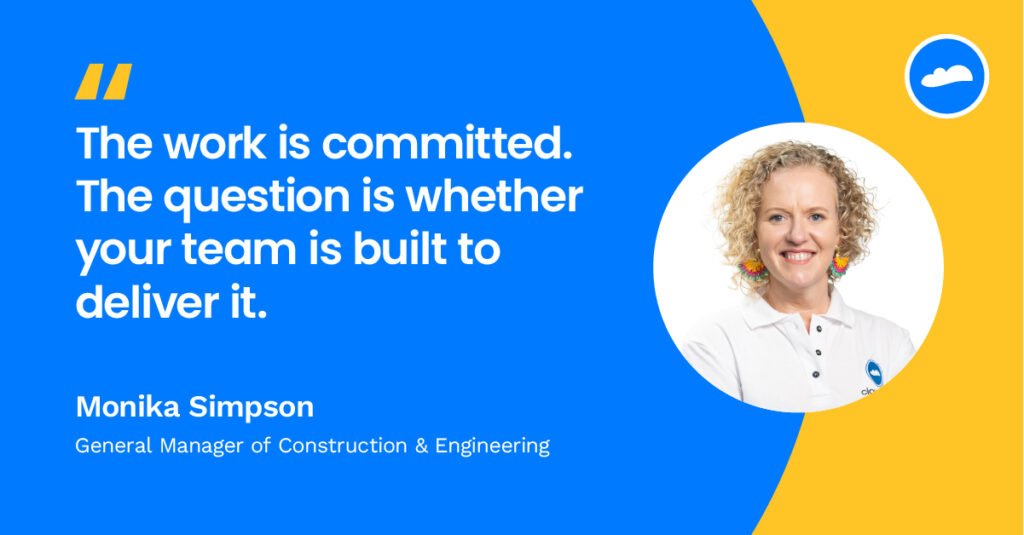
The work is there. The investment is committed. The question every construction business would benefit from asking right now is whether its team structure is genuinely built to match the opportunity ahead.
About the Author
Monika Simpson is the General Manager for Construction and Engineering at Cloudstaff, where she works with construction, engineering, and design companies across APAC to build workforce models that support growth without compromising quality or compliance. With deep experience in workforce strategy and operational delivery, Monika focuses on helping teams design sustainable capacity so local professionals can stay focused on high-value work.
Ready to build capacity for your infrastructure pipeline?
Explore how Cloudstaff’s skilled virtual professionals are supporting construction and engineering teams across Australia. Visit cloudstaff.com/au/construction or book a meeting with Monika here.