
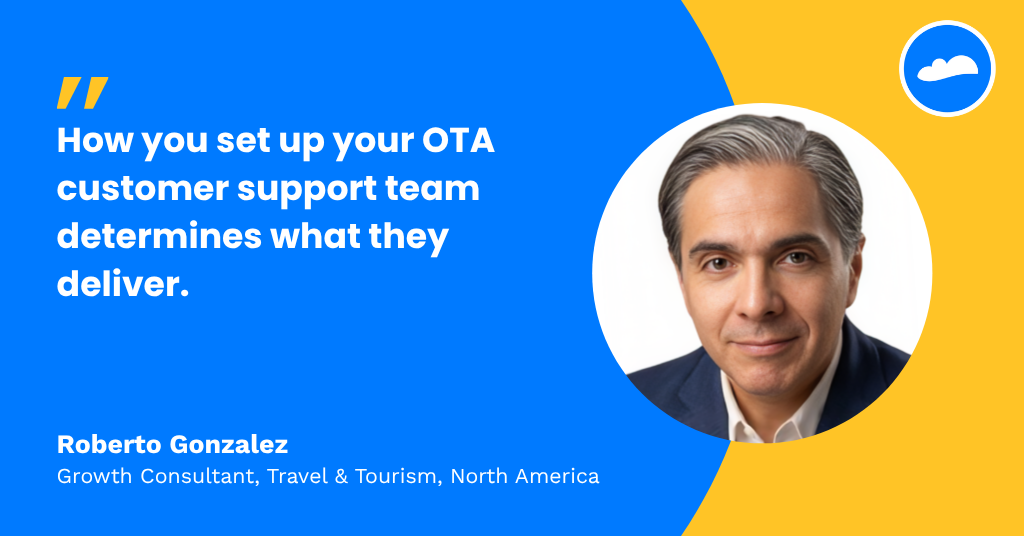
By Roberto Gonzalez
After more than 20 years working across cruise operations, loyalty travel programs, and large-scale global contact centers, I have had the chance to build and oversee a lot of teams. Some found their footing quickly. Others took longer. The difference was rarely about where the team was located. It was about how they were structured, equipped, and supported from day one.
Online travel agencies (OTAs) sit at the intersection of high transaction volume, emotionally charged customer moments, and constant operational complexity. Your customers are booking at midnight, rerouting trips from airport lounges, and reaching out across multiple channels with varying levels of urgency. Travel does not pause. Customer expectations follow the same rhythm.
According to Salesforce’s State of Service Report, 88% of customers say the experience a company provides is as important as its products or services. In travel, where the stakes of every interaction are high, that expectation shapes everything about how your support team needs to operate.
That reality makes customer service one of the most natural functions to run remotely. Doing it well requires more than hiring a few agents and pointing them at a ticket queue. Here is what I have seen work.
Remote Customer Service is a Natural Fit for Online Travel Agencies
Travel is a 24/7 industry. Your customers need support on their schedule, across time zones and hours that local office coverage alone cannot reliably reach. A team built across time zones gives you natural coverage without forcing your people into overnight shifts that wear them down over time.
OTAs also deal with inquiry volumes that move with seasons, holidays, and global events. Deloitte’s Global Outsourcing Survey found that 57% of companies use outsourcing to focus on core business functions, while 47% cite cost reduction as a primary driver. For OTAs managing fluctuating demand across seasons and global events, both of those outcomes matter. A remote team gives you the flexibility to scale up during peaks and manage costs when demand drops. And because most OTA customer interactions already happen digitally, through chat, email, phone, and social media, there is no operational reason why the person managing those interactions needs to be in the same city as your headquarters. Further, remote teams help OTAs manage operational costs effectively, delivering significant cost savings during peak seasons without sacrificing service quality.
Building the Right OTA Customer Service Team Structure for Operational Excellence
The most common mistake I have seen is hiring a flat team of generalists and expecting them to handle everything. For instance, disruptions caused by weather or strikes may require OTA specialist assistance for alternative arrangements. Travel customer service has real layers of complexity. Your team structure needs to reflect that from the start.
What has worked consistently across the environments I have been part of is a tiered model:
- Tier 1 frontline agents handle high-volume, straightforward inquiries: booking confirmations, itinerary questions, payment status checks, loyalty program support, and simple modifications. A starting team of four to six agents covering two shifts across your primary time zones is a reasonable foundation.
- Tier 2 specialist agents handle escalations from Tier 1, including complex rebookings, multi-leg itinerary changes, refund processing, supplier disputes, and insurance claims. These cases require deeper product knowledge, stronger judgment, and hands-on experience with GDS platforms. Two to three specialists with on-call coverage during peak hours is a solid starting point.
- Tier 3, your team lead or supervisor, manages quality, handles sensitive escalations, coaches agents, and maintains operational continuity across shifts. Even a small remote team benefits from having one dedicated lead who overlaps with both shifts.
The structure matters because travel situations move fast. A Tier 1 agent who knows exactly when and where to escalate protects both the customer relationship and your supplier and partner relationships. In my experience, protecting the partner experience is often the harder part of the job to get right. Hiring qualified candidates who understand the unique challenges of the travel industry ensures your team can deliver proactive, personalized support that builds customer loyalty.
Documentation: Key to Enhancing Customer Experience and Operational Efficiency
Remote teams are only as effective as the systems and documentation behind them. At a minimum, you need a help desk and ticketing platform, live chat capability, phone and VoIP support, internal communication tools, a customer knowledge base, a CRM, quality monitoring, and workforce scheduling. Providing agents with instant access to comprehensive customer data and automation tools enables them to guide customers efficiently and reduce wait times.
The knowledge base is the one most often underdeveloped and the one that causes the most pain when it is missing. Travel products are complex. Agents need fast access to booking policies, supplier rules, cancellation windows, fare classes, and destination-specific information. A well-maintained knowledge base cuts handling time and reduces errors significantly.
Your standard operating procedures matter just as much. In travel, situations escalate quickly. Your agents need clear processes for booking modifications, cancellations, refunds, travel disruptions, escalation paths, complaint handling, and fraud detection. These documents are your training foundation and your quality benchmark. When something goes wrong at 2 AM and there is no manager available, your SOPs are what keep the operation running.
Strong Onboarding to Equip Your Travel Business for Success
Remote agents build knowledge through structured programs. The informal learning that comes from proximity to experienced colleagues works differently in distributed environments, which makes deliberate onboarding essential.
A solid onboarding plan for OTA customer service agents typically runs two to three weeks and should cover your booking platform and internal systems, product knowledge across destinations, suppliers, fare types and packages, channel-specific communication standards, SOPs and escalation procedures, and practice scenarios before agents go live.
After onboarding, plan for ongoing training. Travel products change constantly. New suppliers come on board. Policies shift. Destinations open and close. Your team needs to stay current. Ongoing training equips employees to handle complex tasks and adapt to the unique needs of travelers, enhancing the overall customer experience.
Measuring Service Quality and Customer Experience in Your OTA Customer Service Team
82% of service professionals say customer expectations are higher now. In travel, a fast response with inaccurate information tends to create more problems than it resolves. Accuracy is what actually protects the customer relationship. Track both dimensions consistently.
The metrics worth tracking closely:
- First response time
- Average handling time
- First contact resolution
- Customer satisfaction (CSAT)
- Quality assurance score
- Escalation rate
- Agent utilization
Review these weekly with your team lead. Monthly, look at trends and adjust staffing, training, and processes accordingly. Further, tracking expense and operational metrics alongside customer satisfaction helps identify staffing needs and optimize team performance.
Common Challenges Travel Agencies Face in Managing Remote OTA Customer Service Teams
- “Our remote agents do not understand our brand voice.” Brand voice consistency comes from how you train people and what you document. Build a brand voice guide with real examples of strong and weak responses and review interactions regularly with specific feedback.
- “Quality drops during off-peak shifts.” Make sure overnight and weekend shifts are staffed with a spread of experience levels. Keep a Tier 2 agent or lead always reachable regardless of the hour.
- “Customers complain about language barriers.” Hire for communication skills first. The Philippines has a large English-speaking talent pool with a strong service-oriented culture, which is why it has become a hub for travel customer service. Colombia is strong for bilingual English-Spanish interactions. India supports omnichannel customer service well. Many organizations find that investing in resources to recruit multilingual agents reduces communication barriers and improves personalized service.
- “We cannot manage a team we cannot see.” This is where your staffing model matters. With the right approach, your team works in a professional environment with IT, HR, and facilities support handled for you, while you retain full control over the work. You are managing remotely with proper infrastructure behind your people.
Beyond Customer Service: How Travel Agencies Gain Access to Remote OTA Support Functions
Customer service draws the most attention, but OTAs have a wide range of functions that are just as well suited to remote teams. For instance, remote teams can also support critical financial tasks such as expense tracking and refund processing, helping OTAs control costs and improve accuracy.
- On the operations and booking side: booking verification agents, GDS operators working in Amadeus, Sabre, or Galileo, supplier coordination specialists, and group travel coordinators.
- On the revenue and pricing side: fare loading analysts, revenue support specialists, and yield management assistants who support dynamic pricing strategies with data analysis and reporting.
- On the finance side: accounts receivable and payable specialists, refund processing agents, and financial reporting analysts.
- On the content and marketing side: destination content writers, SEO specialists, social media coordinators, and email marketing specialists.
- On the data and technology side: data entry and cleansing specialists, QA testers, API integration support, and business intelligence analysts.
Critical Factors for OTA Remote Customer Service Excellence
Building a remote customer service team for your OTA is about creating a structure that delivers better customer coverage, faster response times, and consistent quality, while giving your business the flexibility to scale with demand.
What I have seen across two decades in this industry is that the best remote teams feel like real extensions of the business. They come prepared to ask the right questions, build relationships with your partners, and think about outcomes. That level of engagement comes from how you set people up.
Invest in that, and the results follow.
If you are thinking through how to build a dedicated remote team for your travel business, I am happy to talk through what that looks like in practice.
About the Author
Roberto Gonzalez drives growth of Cloudstaff’s North America Travel and Tourism vertical. He brings over 20 years of experience across cruise, loyalty travel, and global operations. He partners with travel and leisure organizations to scale through people-led, technology-enabled workforce strategies that create lasting value for both businesses and their guests.
Ready to build a remote team that becomes a real extension of your travel operation?
Talk to Roberto about what that looks like for your OTA. Travel Agency Support Services