
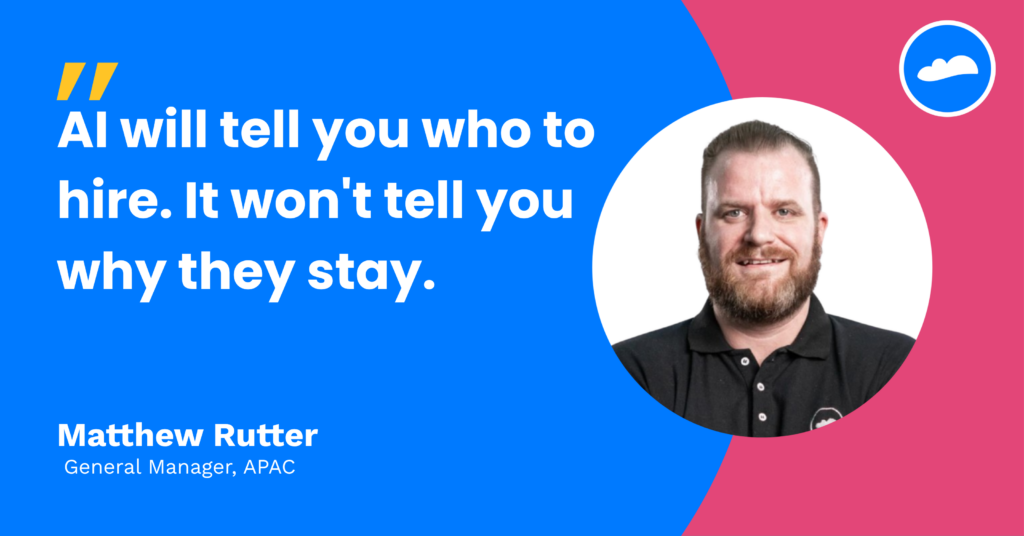
By Matthew Rutter
I have been watching a pattern emerge in nearly every first conversation I have with a business owner considering offshoring. They come in prepared. They have done their research. They have asked ChatGPT, Claude, Gemini, or Microsoft Copilot to outline an offshore staffing strategy, and they have a framework. Cost benchmarks, role profiles, country comparisons, risk factors. On paper, it looks solid.
And honestly? A lot of it is. AI tools are genuinely useful for scoping offshore strategies. The problem is not what they get right but what they consistently miss, and those gaps are exactly where most offshoring relationships quietly fall apart.
Offshore Team Strategy: AI as a Starting Point, Not a Complete Picture
When I type “will AI make offshore teams obsolete?” into an LLM, I get a competent response. It tells me AI is reshaping certain task categories while demand for skilled global teams continues to grow. It reflects the broad consensus of publicly available knowledge, and that consensus is not wrong.
The global offshore software development market reached USD 178.32 billion in 2025 and is forecast to reach USD 204.32 billion in 2026, according to The Business Research Company. That growth is happening precisely because global teams, when built well, deliver real results. AI tools capture this macro picture accurately.
What they cannot capture is the operational texture beneath it. And in offshoring, texture is everything.
Access to global expertise, genuine cost savings, and the ability to scale teams across time zones make offshoring a game changer for businesses that get it right. The challenges are real too. Physical distance, cultural differences, language barriers, and the handling of sensitive information all require deliberate management. But none of them are dealbreakers. They are variables that experienced operators have already solved, and they are creating opportunities for businesses worldwide to compete in ways that were not possible a decade ago.
Common Challenges in Managing Offshore Teams AI Often Misses
1. Building a strong team culture is key for offshore team members.
Every AI response I have seen on offshore staffing mentions “cultural considerations” somewhere near the bottom. It treats culture as a soft variable to be managed, rather than the primary driver of whether a team performs or stalls.
Investing in team-building activities and social events can help offshore team members bond and feel connected, which is vital for building trust.
In the Philippines, where Cloudstaff has operated since 2009, family is not a background factor. It is the core motivation that shapes how people think about their work, their loyalty, and their career decisions. For instance, paying the 13th month bonus early is much appreciated as it changes how a family celebrates Christmas. A team leader who genuinely knows her people is not a management preference. She is the retention strategy.
No AI model surfaces this. It cannot, because this knowledge comes from being on the ground, from thousands of conversations with staff and clients, from observing what actually shifts behaviour when things get hard.
2. Effective communication and infrastructure are vital for managing offshore teams.
Ask an LLM about offshore team risk factors and you will get data security, time zone management, and communication latency. You will rarely get a serious discussion of what happens to your team’s productivity when a typhoon hits and their residential internet goes down, or when a provider’s PCs are running unlicensed software that creates compliance exposure your legal team did not anticipate.
I lent a Cloudstaff Starlink unit to a family for a weekend last year. In three and a half days, they used 165 GB of data across streaming, social media, and video calls. That single experiment told me everything about why residential internet and business-grade connectivity cannot be treated as the same thing. Cloudstaff provides every home-based staff member with a dedicated business internet connection, precisely because we have learned what happens when you leave this to chance.
AI will not tell you to ask your offshore provider how they handle infrastructure during natural disasters. Experienced operators will.
The same principle applies to your communication stack. Establishing clear communication channels from day one, whether through Microsoft Teams, project management tools, or dedicated collaboration tools, removes ambiguity before it becomes a problem. Regular check-ins, agreed response times, and visible project updates keep both sides aligned. The right tools do not replace trust, but they create the conditions for it.
3. Due diligence and mindset shape successful offshore team management.
This is the one I find most important, and the one AI is least equipped to address. Most offshoring relationships that underperform do not fail because of talent quality or cost miscalculation. They fail because the client approached it as a vendor transaction rather than a team integration.
The businesses that get the most out of global staffing treat their offshore team the same way they treat their onshore one. They structure robust initial onboarding programs to align offshore workers with internal systems and expectations. Some even assign a dedicated mentor to guide new members, set clear goals, and offer necessary training and resources to ensure a smooth transition and successful integration. They share context, not just tasks. They communicate intent, not just instructions. They visit. They build culture across borders. When a CFO told me recently that their Cloudstaff team feels like part of their company rather than an external vendor, that did not happen because we wrote it into a contract but because both sides brought the right mindset from the start.
This distinction between transactional and integrated is not something an AI model will prompt you to consider. But it is probably the single biggest determinant of whether your offshore team becomes a competitive advantage or a recurring management headache.
The teams that close that distance fastest are intentional about it. Virtual team building activities, shared online games, and informal check-ins across time zones do more for morale and relationship building than any onboarding document. Physical distance is a logistical fact. It does not have to be a cultural one
A Contrarian Take
I am not arguing against AI. Cloudstaff appointed a Chief AI Officer in 2023. We have been running structured AI training programs for our staff since before it became a headline topic. We believe AI makes well-run offshore teams more capable, not redundant.
What I am saying is this: AI has raised the floor on bad offshoring decisions by making basic information more accessible. It has not raised the ceiling. The ceiling is still determined by the quality of the provider, the depth of cultural integration, the robustness of the infrastructure, and the mindset of the people involved.
McKinsey’s 2025 State of AI research found that only 1 percent of business leaders consider their organizations mature in AI deployment, even as 92 percent plan to increase investment. The gap between using AI as a planning tool and actually embedding it into operations that work is significant. The same gap exists in offshoring.
What to Ask That No LLM Will Prompt You to Raise
Before you commit to an offshore staffing partner, here are the questions that separate providers who genuinely operate well from those who present well:
- What is your staff retention rate, and what drives it? Numbers matter, but so does the story behind them.
- How do you handle connectivity for home-based staff? Who owns the problem when internet goes down?
- Can I visit? Can I meet my team before they start?
- What does your cybersecurity and endpoint management actually look like on the ground?
- How do you invest in the professional development of staff after they are placed?
The quality of your offshore team starts before they begin. A rigorous hiring process, clear role definitions, and well-set expectations from the outset give people the best chance to perform. Tailored training that accounts for your specific workflows, tools, and culture is what turns good offshore talent into a team that understands your business and can grow with it.
The best offshore relationships do not plateau after onboarding. Continuous improvement, regular feedback loops, and tracking progress against clear benchmarks are what separate teams that stay engaged over the long term from those that slowly drift. High performance in a global team is not a one-time achievement. It is a practice.
Use AI to start the conversation. Use human experience to make the decision. The answers to those questions above are not in any training dataset. They live in how a provider shows up every day, and that is something you can only find out by looking.
About the Author
Matthew Rutter is the General Manager, APAC at Cloudstaff and the company’s representative in the Philippines. With over two decades of experience in business development and operations leadership across Australia and the Philippines, he brings a proven track record of scaling teams and building meaningful client partnerships. At Cloudstaff, Matthew leads initiatives to expand market reach and strengthen the company’s position as a trusted partner in the global outsourcing industry.
____________________________________________________________________________________
Ready to build a global team that actually performs?
Explore how Cloudstaff can help: Remote Staffing and Outsourcing