
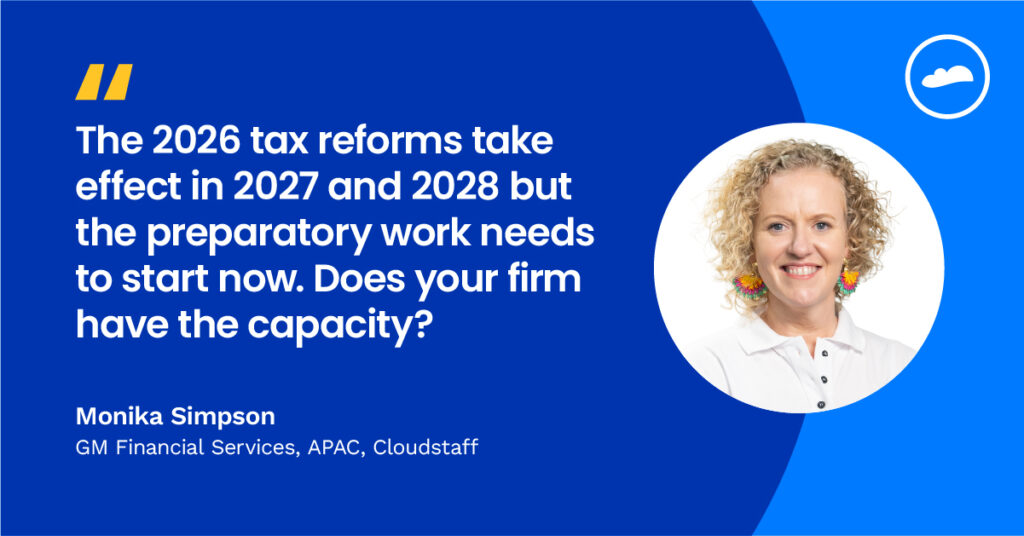
By Monika Simpson
Since taking on the Financial Services vertical for APAC, my conversations with accounting and advisory leaders across Australia keep coming back to the same two dates: 1 July 2027 and 1 July 2028.
Both relate to changes announced in the 2026-27 Federal Budget around capital gains and discretionary trusts.
The technical detail matters, but there is another issue sitting underneath these reforms that I think deserves just as much attention: capacity.
From 1 July 2027, the 50 per cent CGT discount is replaced with cost base indexation and a new 30 per cent minimum tax on certain capital gains, under legislation enacted on 26 June 2026. Assets held by Australian resident individuals and trusts on 30 June 2027 will be deemed to have been sold and reacquired on 1 July 2027 at market value, or at an amount worked out under an applicable apportioning method.
From 1 July 2028, a proposed 30 per cent minimum tax would apply to discretionary trusts, with some exceptions. The measure is not yet law and includes a proposed three-year rollover relief period beginning 1 July 2027 for eligible restructuring.
Those dates still feel a long way off, but finance and accounting teams can’t wait for urgency to build before they start planning.
One thing I’m particularly looking forward to over August and September is getting closer to these conversations through our involvement with CPA Australia, including local breakfast information sessions alongside Chambers of Commerce and the upcoming CPA roadshows. It will be a great opportunity to hear directly from accounting professionals about the challenges they see ahead, from technical detail through to people, workload, and capacity.
What the Work Actually Looks Like
Underneath the tax changes sits a significant body of preparation work for the accounting and finance sector.
Accounting and advisory teams will need to identify which clients may be affected, gather and validate records, coordinate valuations, model different scenarios, update documentation and workflows, and prepare for client conversations well before either deadline arrives.
None of that happens overnight.
More importantly, much of it will land on teams that are already stretched and businesses that are simultaneously trying to protect their senior people’s time for higher-value advisory work.
The real issue is whether teams have enough of the right capacity, at the right level, when the workload starts to build.
The Real Constraint on Capacity
One of the recurring themes in my conversations with accounting leaders is how much senior capacity is still consumed by work that doesn’t necessarily require senior judgment.
Much of that work is reconciliation, data validation, valuation preparation, cost base calculations, documentation, file preparation and modelling support. All of it is important, though not all of it requires senior-level judgment.
There is a useful distinction to make between the work that genuinely requires experience and judgment, and the preparation work that can be built to scale under clearly defined standards.
Judgment work that belongs with senior finance professionals:
- Client strategy conversations around restructuring options
- Interpreting modelling and making recommendations
- Reviewing and signing off on complex structures
- Managing client relationships through the transition
Preparation work that can scale across finance roles:
- Identifying and segmenting potentially affected clients
- Gathering records for asset and trust valuations
- Cost base calculations and scenario modelling support
- Trust register updates and documentation
- Workflow and file preparation ahead of client conversations
The earlier practices draw that line, the more opportunity they have to protect their experienced people’s time for the work only they can do.
Building Capacity by Finding Great Talent Before Every Client Calls
The opportunity right now is time.
Accounting and advisory businesses can ease the heavy lifting and use the runway ahead to map which clients may be affected, understand the likely workload and decide how that work should be distributed across the team, well before the deadlines create urgency.
That means asking some practical questions now.
Which work genuinely needs to stay with partners and senior accountants? Which preparation work can be standardised? Where are the existing capacity gaps and hiring needs? And if additional capability is going to be needed, how long will it take for your accounting and finance recruitment to access the right candidate, ensure cultural fit, onboard, train, and integrate those people properly?
This is where global delivery capacity can earn its place in the conversation.
Global delivery capacity can build additional capability underneath senior tax expertise, giving teams the bandwidth to absorb a genuine, time-bound increase in preparation work while keeping experienced people focused on advice, oversight, financial planning, and client relationships.
The Question Worth Asking Now
The tax detail belongs with tax advisers.
The workforce question belongs with whoever is responsible for how a business’s capacity is built with confidence.
And that question is worth asking well before 2027.
Every accounting and advisory business has the same runway to prepare. The difference will be what they do with it, and whether they wait for the workload to arrive before building the capacity to handle it.
The teams getting ahead of this are thinking beyond what the reforms mean for their clients, to who is going to do the work when those clients need them.
About the Author
Monika Simpson is General Manager for Construction, Engineering and Financial Services, APAC, where she works with companies across the region to build workforce models that support growth, protect quality and strengthen compliance.
She focuses on helping teams design sustainable capacity so onshore professionals can stay focused on judgment, oversight and client relationships.
Ready to see how your firm can build capacity ahead of the 2027 and 2028 tax reform deadlines?
Visit Remote Finance & Accounting Outsourcing Solutions – Cloudstaff or book a conversation with Monika.