
By Ivan Popic
When I talk with US executives about what’s actually frustrating them about their extended teams, three things come up almost every time.
The first is what I’ve started calling the ping-pong effect: a question sent at 3 p.m. Eastern that doesn’t get answered until the next business day, because the person who could answer it just clocked out for the evening. The second is a subtler kind of friction, accents and phrasing that never quite land the same way twice, especially in front of a client. The third is the one that wears on people the most: the US manager who is still on a call at 11 p.m. because that’s the only hour their global team has free.
Individually, each one is manageable. Stacked together across a week, they quietly erase a good part of the capacity a business thought it was buying.
Why Nearshoring to Bogotá Solves the Clock Problem for North American Businesses
The fix I keep pointing US leaders toward is simple: pick a location where the clock already works in their favor.
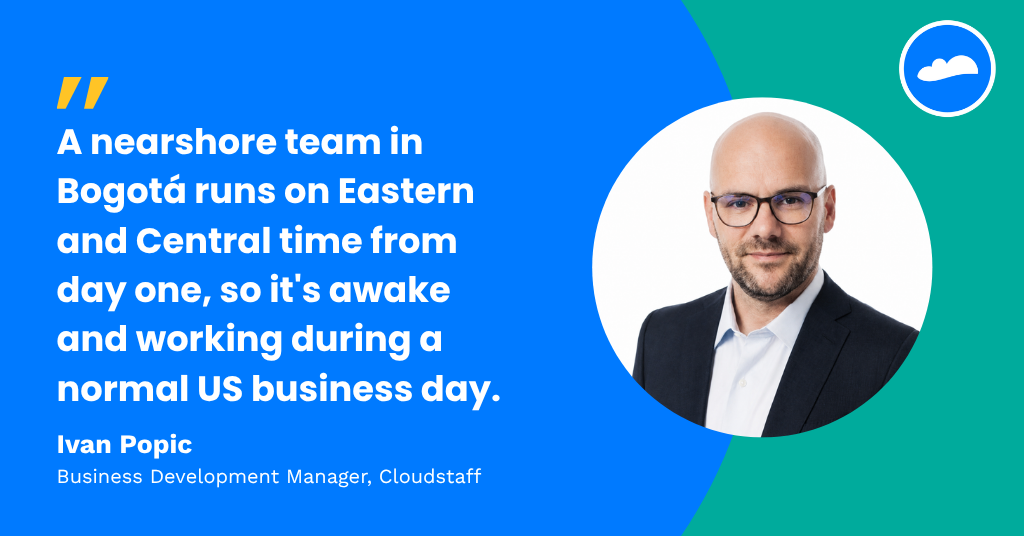
This is the real distinction between nearshoring and the model most people still picture: an offshore team in places like Eastern Europe or Southeast Asia often works outside the same time zone, so companies trade speed for savings. On the other hand, a nearshore team in Bogotá operates on Eastern and Central time from day one, giving US companies strong time zone alignment and real time collaboration during normal US working hours.
Standups happen at 9 a.m., matching the actual US workday, while the people who need to make decisions are online and available. With nearshore outsourcing, US companies can manage teams in closer alignment with their working hours, without giving up access to skilled talent.
Time zone overlap draws people in first, and it’s one of several reasons Bogotá keeps coming up in these conversations. As a nearshore destination in South America, Colombia has spent more than a decade building a genuinely bilingual workforce to support nearshore and virtual staffing partnerships with the US.
Invest in Bogotá counts more than 1.3 million English-proficient professionals in the country. Colombia’s talent base is also known for strong English proficiency, with the national bilingualism program expanding English instruction through the university level. This creates a growing talent pool for businesses looking to build teams across global markets.
What’s Really Driving the Nearshore Talent Shift to Bogotá in Latin America
The bigger shift I’m watching is why leaders are choosing Bogotá in the first place. A few years ago the honest answer was almost always price. Deloitte’s 2024 Global Outsourcing Survey found cost reduction fell from the top reason 70% of companies gave for building an extended team in 2020, down to just 34% today, with access to skilled talent and operational agility now sitting alongside it.
That tracks with what I hear directly. The first conversation with a US leader usually centers on culture fit and growth speed: whether the team understands US business well enough that a client never has to ask something twice, and whether that team can scale up in weeks instead of quarters. Experienced professionals are increasingly part of that conversation, particularly when businesses are considering international hiring to fill skills gaps. The cost advantage is real too, with cost savings typically reaching 30 to 50% against equivalent US hires. It tends to surface in the third or fourth conversation, once those questions are already answered.
Where the work actually happens matters too. For instance, our Bogotá team operates out of Connecta 26, five minutes from El Dorado International Airport. Connecta 26 is a LEED-certified business ecosystem built for the kind of infrastructure US clients expect: dependable power, real security, and the consistency needed to support quality service and operational efficiency.
What to Actually Evaluate Before You Commit
If your business is evaluating nearshoring to Colombia for the second half of the year, here’s the checklist I’d use to cover the entire process to hire nearshore talent through one focused partner, in this order:
- How many hours of your actual workday overlap with theirs, and how does time zone compatibility plus easier travel to a nearby country improve collaboration and support your operations?
- How is English proficiency verified?
- What happens to institutional knowledge if a team member leaves eighteen months into the relationship, and do people work exclusively for your company as a dedicated team?
- Can they show you the actual facility, security protocols, and retention numbers?
Extending a team through outsourcing should give a business back time, focus, and a manager’s evenings. Getting the time zone right is the first fix. Getting the talent, the infrastructure, and the retention right is what makes it last, and strong placement results matter for long-term quality.
If you’re working through this for the second half of the year, I’d like to hear what’s been the hardest part to solve.
About the Author
Ivan Popic is a business development strategist with over 15 years of experience building client relationships and driving growth across multicultural markets. He joined Cloudstaff as a Growth Partner, was appointed Acting Country Manager for Colombia in early 2026, and now Business Development Manager. Based in Bogota, he works closely with US firms building virtual staffing teams in Colombia, helping them expand capacity in ways that work for their people and their clients. His entrepreneurial background and relationship-driven approach shape how he engages every partnership, with a focus on outcomes that last.
Thinking about extending your team into Colombia?
Talk to Ivan and the Cloudstaff Colombia team. Colombia – Cloudstaff