
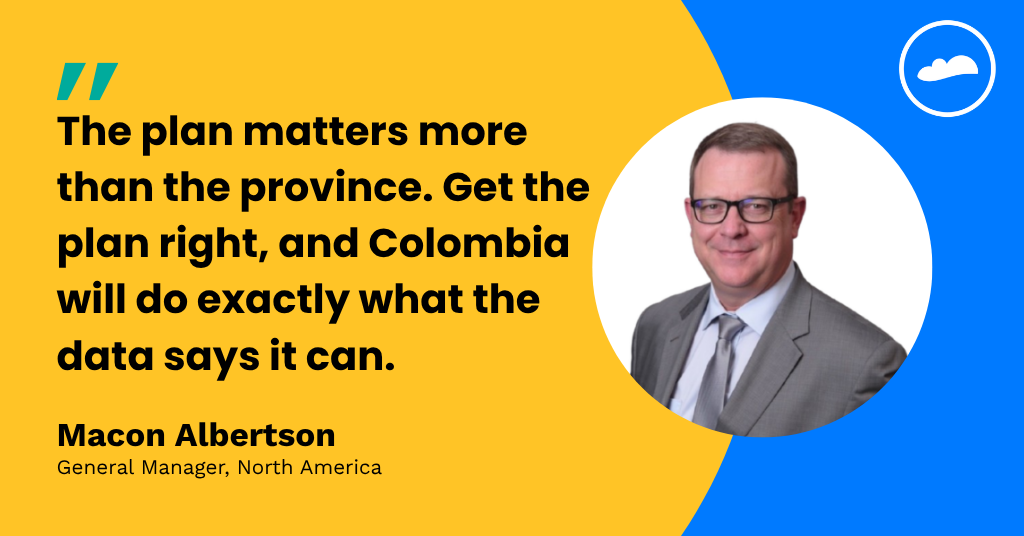
By Macon Albertson
Every year, a US company tries Colombia for the first time, hits a rough quarter, and writes off the whole idea. The story that gets told afterward almost always blames the country. In twenty-five years building staffing organizations across the US, I have rarely seen that hold up. The plan the company walked in with is usually the real problem, and a plan problem is fixable.
That distinction is worth sitting with, because the cost of getting hiring wrong is not a Colombia problem. SHRM puts the cost of replacing an employee at 50 to 200 percent of their annual salary. Gallup estimates voluntary turnover costs US businesses roughly a trillion dollars a year. Those numbers describe domestic hiring costs, and they climb even higher in markets like Miami, where competition for bilingual talent is already intense. Colombia adds another well-qualified market to draw from, taking pressure off an already tight domestic pool. Companies that treat their first Colombia hire as a cheaper, lower stakes version of a US hire are the ones who get burned.
The Mistakes and How to Avoid Them
1. Picking a partner on price, not on process
The fastest way into trouble is comparing hourly rates and stopping there. Rate tells you almost nothing about how a candidate was screened, how deep the bench is behind that first hire, or what happens when someone leaves. A market can have outstanding talent and you can still end up with a weak hire if the vetting process behind it is thin. Ask a potential partner how many candidates they screen for every one they present, and ask what their replacement process looks like before you ask about cost.
2. Walking in without a 90-day plan
Domestic new hires get structure without anyone thinking about it. They sit near a manager, pick up context in hallway conversations, and get corrected quickly when something is off. None of that happens automatically with a hire in another country. If you have not defined the first 90 days before day one, including what success looks like in week two, week six, and week twelve, you are running an experiment, not a hire. Companies that skip this step are the ones who call three months later wondering why performance never took off.
3. Underestimating the market you are actually entering
Colombia in 2026 is not the Colombia most executives picture. ProColombia reports the country’s services sector now employs more than 710,000 people directly, concentrated in Bogotá, Medellín, Cali, and Barranquilla. Bogotá alone accounts for 70 percent of the sector’s revenue, backed by a workforce of six million people, 71 percent of whom make up the country’s bilingual talent pool, according to Invest in Bogotá. The region also drew 105 new and expansion foreign investment projects in 2024, an 11.7 percent increase over the year before, representing close to 2.4 billion dollars and more than 12,000 new jobs. Companies that treat Colombia as a backup plan or a discount option are working from an outdated picture, and it shows in how they scope the role, set the budget, and pitch the opportunity to the person they hire.
4. Assuming retention is someone else’s problem
This is the one that costs the most and gets talked about the least. A company hires well, onboards reasonably, and then treats the placement as finished business. Retention is not automatic anywhere. It comes from genuine investment: real career development, real inclusion in company decisions, and a partner who treats the retained employee as a long-term asset rather than a line item. Skip that step and you are back to paying the replacement cost SHRM and Gallup put a number on, except now you are also paying to rebuild trust in the model itself.
None of these mistakes are about Colombia specifically. They are about what happens when a company brings a domestic hiring mindset to a decision that deserves more structure, not less. The good news is that every one of them is preventable, and companies that get it right the first time rarely go back to doing it any other way.
Why Colombia Delivers When the Structure Is Right
Colombia has become a serious option for US companies building teams outside the domestic market. Not because it is inexpensive, but because the fundamentals allow teams to operate without unnecessary friction.
The time zone alignment is a practical advantage. Teams can work within the same business day, which keeps communication direct and decisions timely. That changes how teams collaborate. Issues get resolved faster, and managers stay closer to day-to-day performance.
The depth of the talent pool also matters. Companies are not limited to one type of role. They are building teams across software development, finance, healthcare support, customer operations, and sales. That range allows organizations to scale different parts of the business from one location rather than spreading roles across multiple markets.
Just as important is cultural alignment. Professionals in Colombia are used to working with US companies, which supports clear expectations and effective communication from the start. When teams share working hours, language, and operating standards, they integrate more naturally into existing workflows.
When those fundamentals are in place, companies move past the idea of outsourcing. What they build instead is a team that functions as part of their core operations, with the same level of accountability and performance.
If you are building your first team in Colombia this year, the plan matters more than the province. Get the plan right and Colombia becomes one of the most reliable ways to build a high-performing, nearshore team.
About the Author
Macon Albertson is General Manager, North America at Cloudstaff, bringing more than 25 years of experience in staffing, workforce strategy, and operational leadership across the US market. He helps US companies build scalable international teams that deliver real, measurable business outcomes. At Cloudstaff, he leads the build-out of the company’s North American sales presence and its growing bilingual staffing capability in Colombia.
Learn more about building a team in Colombia: Colombia – Cloudstaff