
By Jamar Mitchell
I spend a lot of time talking with leaders running collections operations across the US. The conversations sound different on the surface: different portfolio types, different creditor relationships, different markets. But the underlying pressure is remarkably consistent right now. Volumes are up. Household debt in the US hit $17.5 trillion in late 2024, and delinquency rates are climbing. But margins aren’t following. Labor keeps taking a bigger share of revenue, compliance costs keep rising, and the collectors you do bring on are walking out the door faster than you can replace them.
The industry’s annual collector turnover runs between 30 and 45 percent. Average tenure sits around 18 months. When you add up recruiting, onboarding, training, and the ramp time before a new hire actually becomes productive, that’s a real and recurring cost.
Most agency leaders respond the way their predecessors did: hire more domestic staff, open more seats, absorb the cost. That approach made sense when margins were wider. It’s becoming harder to sustain.
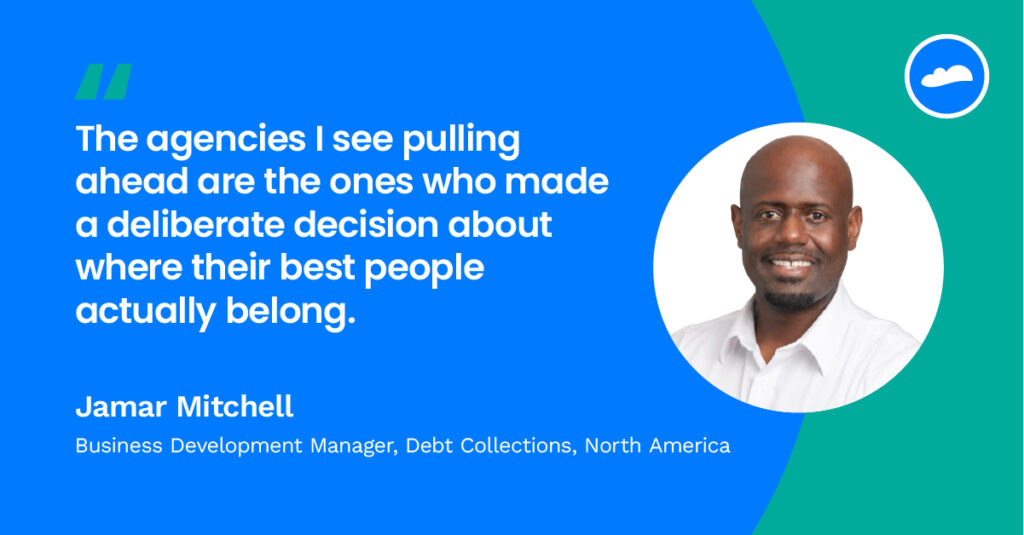
The agencies I see building operations that hold up over time are making a different call. They’re asking where their best people and their capital are most effectively deployed, and outsourcing is increasingly part of that answer.
What Outsourcing Actually Addresses in Collections
Let me be specific about the problem, because the framing matters.
Most outsourcing conversations start with labor cost arbitrage, and that number is real. Fully loaded offshore staffing typically runs 50 to 60 percent below comparable domestic hires once you account for salary, benefits, payroll taxes, recruiting, training, and facilities. For an agency running 50 collectors, that’s not a line item saving. It changes the unit economics of the whole operation and can improve cash flow immediately.
But the structural benefit that gets less attention is the shift from fixed cost to variable cost. Collections agencies deal with genuine volume swings: portfolio acquisitions, seasonal patterns, creditor placement cycles. Fixed domestic headcount can’t absorb those efficiently. A dedicated global staffing model lets you scale up for a large placement and pull back when volume drops, without severance exposure, facilities cost, or HR complexity. Immediate setup when placements surge can improve cash flow right away.
That kind of flexibility has real value on its own. And for agencies trying to compete for larger creditor relationships, it can be the thing that makes a contract winnable.
On Compliance and Fair Debt Collection Practices: The Objection I Hear Most Often
The pushback I hear most consistently from agency leaders goes something like this: we can’t outsource because of FDCPA, CFPB oversight, and data security, even though this law, related regulations, and operating rules already define how debt collectors are expected to work.
That concern was more legitimate five or ten years ago than it is today. The Fair Debt Collection Practices Act was enacted in 1977 and significantly amended in 2010, so the framework has evolved well beyond older assumptions.
The compliance infrastructure available to offshore or nearshore collections operations has changed significantly. Serious outsourcing partners build compliance as a core part of what they deliver. SOC 2-certified environments are standard. AI-powered tools enforce call scripting guardrails and Regulation F (effective November 30, 2021) requirements in real time, regardless of where the agent is sitting. They also help support requirements like sending a written notice within five days of initial contact and limiting third-party outreach without consent, except when seeking location information tied to the consumer.
What I think gets missed in this conversation is that compliance risk is more of an infrastructure problem than a geography problem. An underfunded domestic operation with weak QA, inconsistent monitoring, and a high-turnover floor carries serious compliance exposure. A well-run offshore or nearshore program with the right technology and dedicated QA staff can outperform it on every metric that actually matters to regulators. Violations tied to outreach practices can also create TCPA exposure through this process, including $500 for negligent violations and $1,500 for willful violations.
The CFPB’s own enforcement record makes this point clearly. Domestic operations have never been exempt from scrutiny. With state attorneys general stepping up enforcement activity through 2025 and into 2026, the compliance burden is intensifying across the board. The question is whether your infrastructure is solid, not where your collectors are located. Strong compliance infrastructure helps teams identify the consumer reporting agency standards that are relevant and the extent to which a partner can support them in a reasonable manner.
On Performance: An Honest Take
Offshore conversion rates don’t always match domestic benchmarks at launch. That’s true, and it’s worth saying directly rather than glossing over it. But specialized collection companies bring the expertise and professionals needed to improve recovery over time.
What the agencies that have struggled with offshore performance tend to have in common is that they approached it like a commodity purchase. Accounts went to a shared BPO pool, training investment was minimal, and results were measured at 30 days. That setup tends to disappoint.
The ones that have gotten real traction offshore consistently do a few things differently:
- Account segmentation: Not all debt is suited for the same channel. High-balance accounts with complex repayment negotiations are better handled domestically or nearshore, especially when determining how to recover amounts owed or manage debts owed. Early-stage, high-volume, lower-balance queues are where offshore staffing tends to deliver the strongest return.
- Dedicated vs. shared staffing: Teams that work exclusively on your portfolios learn your creditor relationships, your compliance posture, and your workflows, which supports stronger recovery efforts because they understand debtors and portfolio nuances. Shared pool models don’t build that kind of institutional knowledge.
- Ongoing training investment: The programs that perform well treat training as ongoing, not a one-time onboarding exercise, and strong agencies use negotiation tactics to improve recovery success as they collect through compliant conduct with debtors. Cultural fluency programs and real-time coaching close the performance gap faster than most agencies expect going in.
The gap is real but it’s closeable. And given the cost differential, even a moderate discount against domestic benchmarks often still produces better economics and can improve recovery rates significantly when the model is well matched to the account mix.
Questions Worth Working Through Before You Decide
Before any conversation about vendors or models, it’s worth being honest with yourself about a few things:
- What percentage of our revenue currently goes to labor? Is that trend moving in the right direction?
- What is our fully loaded cost per collector seat, accounting for recruiting, training, management overhead, and real estate?
- Where does our team spend the most time on high-volume, lower-complexity work that could be systematized?
- What would it mean for our growth trajectory if we could scale headcount at 50 to 60 percent of current cost?
- Do we have the compliance and technology infrastructure to support and monitor a distributed team?
A portfolio audit matters here too, including determining which account segments involve the most suitable transaction types for outsourcing. An honest look at your account types will almost always surface a segment where outsourcing makes clear sense, even if another segment is better handled domestically. A hybrid approach, domestic for complex and high-balance accounts and offshore/nearshore for volume and early-stage queues, is often where the economics land most favorably, since different account categories may be subject to different operational and compliance considerations depending on the nature of the work.
What to Actually Look for in a Partner
This isn’t a commodity purchase, and the stakes are higher than a typical vendor decision. The partner you choose becomes an extension of your business, protecting compliance while supporting customer relations and your brand relationship with creditor clients. A few things matter more than others:
- Collections-specific experience: A general BPO that handles customer service and tech support isn’t the same as a partner who understands FDCPA workflows, debt validation requirements, the specifics of Regulation F’s 7-in-7 rule, and how to collect while preserving customer relations.
- Dedicated staffing model: Teams working exclusively on your portfolios learn faster, perform better, and create accountability that shared pools can’t replicate, while helping a committed team better serve clients and portfolios over time.
- Technology integration capability: Can their staff work natively in your collections platform? Friction in the tech stack is a drag on performance that compounds over time.
- Compliance credentials: Ask for SOC 2 certification, data security protocols, and client references from regulated industries specifically, and confirm the entity can avoid unfair practices, never use unfair tactics, and handle consumers with respect.
- Transparency: Real-time reporting, open QA access, and honest performance dashboards. Vendors who go quiet when results disappoint are a red flag.
Many organizations outsource these services on a contingency fee basis, so pricing model should be evaluated alongside controls. A good collection company operates with sensitivity and tact to preserve future business opportunities.
Start with a pilot. Define the scope, set the KPIs, establish performance gates. The programs that scale well almost always started with a disciplined pilot rather than a wholesale shift.
Where the Debt Collection Industry Is Heading
The BLS projects a 10 percent decline in collector employment through 2034, driven largely by automation and offshoring. The industry is consolidating. IBISWorld data shows agency employment declining 6.4 percent over the past five years, while revenue is expected to climb 6.1 percent in 2026 as delinquency-driven placements accelerate. The U.S. accounts receivable management market is projected to reach $5.32 billion by 2029. The industry is growing at a CAGR of 11.84% from 2024 to 2029. Meanwhile, 55% of all B2B invoiced sales in the U.S. are overdue. The agencies growing in that environment are doing more volume with leaner domestic footprints, supported by global staffing and technology; that reality underscores the crucial role of specialized professionals and better allocation of operational resources as pressure and demand increase.
The agencies still asking whether to consider outsourcing are already behind the ones that have been running hybrid models for three to five years. The more useful question is how to build a program that performs reliably, holds up under compliance scrutiny, and creates the financial flexibility you’re looking for.
That’s a solvable operational problem. But it requires treating it as a strategic decision, not a cost-cutting exercise.
What the Math Tells You
The agencies that built outsourcing programs five years ago have a cost structure that’s genuinely hard to compete against on the same accounts. That gap will keep widening, reflecting both lower operating costs and stronger recovery on the right account types.
Run the numbers on your current cost per seat. Audit your portfolio for segments that are ready for an offshore model. And have an honest conversation about whether the compliance hesitations holding your agency back are grounded in today’s reality or an older version of what outsourcing looked like, and whether outsourcing should involve only the relevant functions and controls needed to save money without increasing compliance exposure.
The window is open. Whether you move through it is a business decision worth making deliberate.
About the Author
Jamar Mitchell is Business Development Manager at Cloudstaff, where he works with debt collection agencies and healthcare organizations across the US to build offshore staffing models that hold up in regulated environments. He brings more than 15 years of experience leading contact center and inside sales organizations, including nearly a decade at Verizon managing large-scale operations under complex compliance requirements.
Want to see what dedicated staffing for an offshore collections team actually looks like in practice?
Check out what a pilot could look like for your agency: Debt Recovery Outsourced Staffing Solutions