
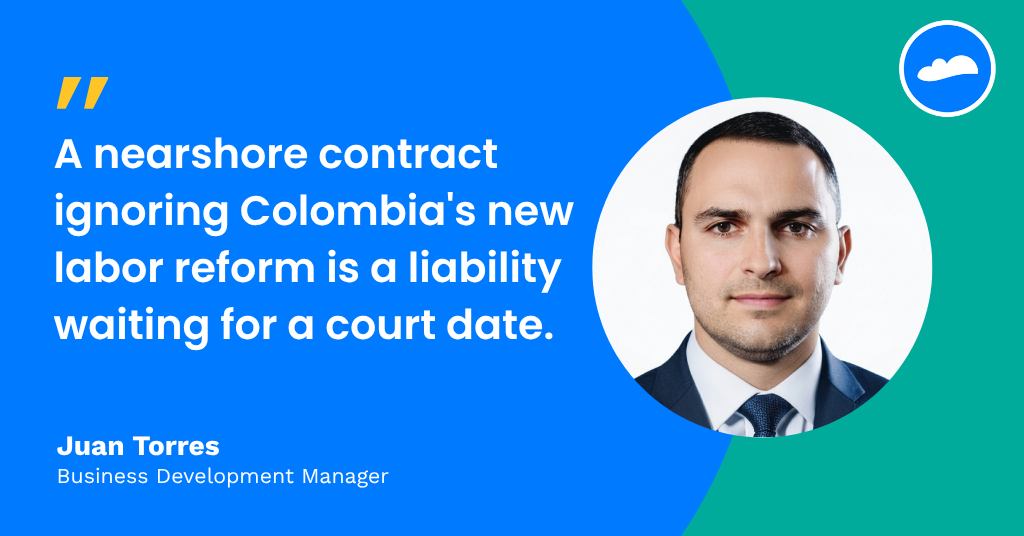
By Juan Torres
For the past few years, the conversation with US law firms exploring Colombia has centered on whether nearshore legal support actually works. That question has largely been answered. Firms across employment law, healthcare, and financial services have built stable, long-tenured legal support teams in Bogotá, and the model has moved from pilot program to standard practice for many of them.
As firms scale their legal teams in Colombia, I now get questions from firms on what they need to understand about the ground shifting under them.
The Regulatory Shift Firms Need to Know About Employment Contracts and Labor Laws
In June 2025, Colombia enacted Law 2466, a labor reform that amended the country’s Labor Code to establish indefinite term contracts as the general rule of employment and placed new restrictions on fixed term and outsourcing arrangements, according to the official statutory text published by Colombia’s Departamento Administrativo de la Función Pública. The law confirms that a fixed term or outsourcing arrangement that doesn’t meet the required conditions is treated as an indefinite term employment relationship from the start of the working relationship, enhancing job security and strengthening the rights of workers.
For firms evaluating or scaling a legal support team in Colombia, this matters more than it might initially appear. The reform sharpens a distinction that has always existed but is now under closer scrutiny: staffing arrangements built on direct, formal employment are treated very differently under Colombian law than arrangements that rely on loosely structured intermediaries covering what are effectively permanent roles.
Why This Lands at a Consequential Moment for Nearshore Staffing in Latin America
The timing matters because legal demand keeps climbing. Legal occupations overall are projected to grow at roughly the average rate for all US jobs through 2034, while the Bureau of Labor Statistics projects little to no growth in paralegal and legal assistant employment over that same period. More firms will be evaluating nearshore partners in Colombia over the next several years to close that gap, arriving at exactly the moment the regulatory bar for how those partnerships are structured has risen.
What Compliant Employment Contracts and Contract Management Look Like for Legal Process Outsourcing Partnerships
For firm leaders, employment structure deserves as much scrutiny as geography when evaluating a provider. A few questions are worth asking before building a team in Colombia:
- Are the professionals directly and formally employed, or engaged through a layered subcontracting arrangement
- Does the provider operate its own registered entity in Colombia, or route employment through a third party
- How does the provider handle the reform’s changes to contract terms, night shift definitions, and mandatory benefits
- What happens to the team and its institutional knowledge if the underlying staffing arrangement gets challenged as noncompliant
Firms that ask these questions upfront avoid a costly problem later. A nearshore contract ignoring Colombia’s new labor reform is a liability waiting for a court date. A legal support team that has spent two years building institutional knowledge of a firm’s case management systems and client relationships represents real value. That value stays secure only if the employment structure underneath it can withstand regulatory scrutiny.
What This Means for Law Firm Leaders Outsourcing Legal Tasks
The 2025 Colombia labor reform introduces significant changes that impact how law firms structure their nearshore legal support teams. With indefinite term contracts now the default employment model, firms must prioritize hiring employees under compliant contracts that offer stability and social security contributions. This shift not only aligns with international labor standards but also enhances service quality by fostering long-term relationships with skilled professionals including attorneys and top talent with legal work expertise and other law firm routine tasks.
In the legal industry, where confidentiality agreements and precise client communication are paramount, having a remote team employed directly under Colombian labor law ensures better compliance and reduces risks associated with noncompliant staffing arrangements. Moreover, the reform’s provisions for flexible schedules and accommodations for caregiving responsibilities or health emergencies demonstrate a modern approach to work-life balance, which can improve employee satisfaction and retention.
Needless to say, by investing in compliant employment structures and regulatory requirements, employers can safeguard their operations against legal risks while accessing bilingual professionals who provide cultural alignment and seamless integration with US-based teams.
Ultimately, law firms that treat their nearshore legal support as a core function, built on a foundation of direct employment with appropriate rest periods and protections for occupational risks, will be best positioned to sustain growth and success in a competitive market.
Colombia’s reform reflects a market maturing in a direction that serves firms well. Formal, direct employment models tend to reduce attrition and strengthen the long-term institutional continuity that makes nearshore legal support with staff bilingual in English and Spanish valuable in the first place.
If your firm is building or scaling a legal support team in Colombia, how much visibility do you have into the employment structure underneath it? That’s worth a conversation before it becomes a problem.
About the Author
Juan Torres is a Business Development Manager at Cloudstaff, specializing in nearshore legal support for US law firms and organizations with complex legal operations. He works with leaders to build scalable, people‑first legal teams aligned to long‑term growth.
Explore how Cloudstaff builds compliant, direct-employment legal teams in Colombia: Remote Legal Staff for US Law Firms – Outsourced Paralegals | Cloudstaff