
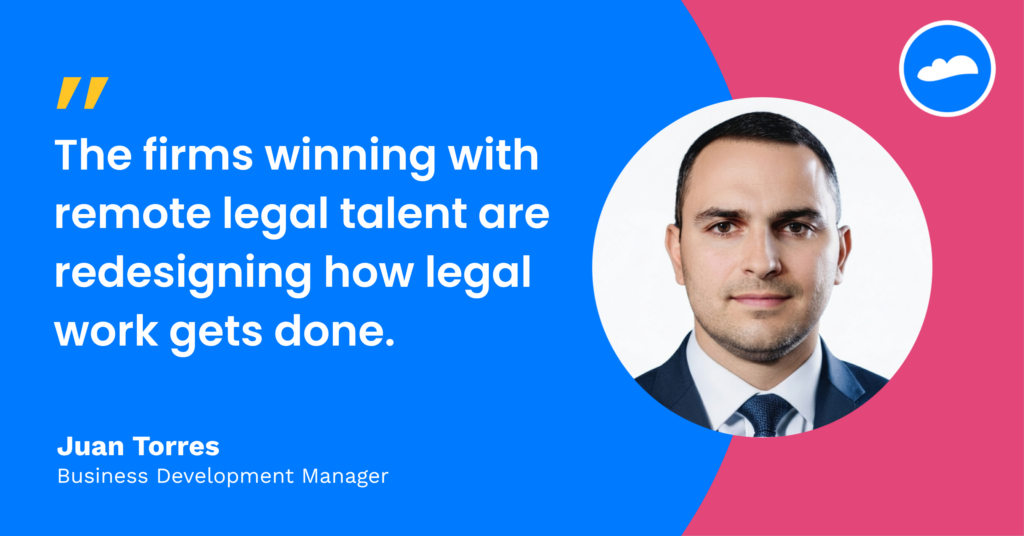
By Juan Torres
In my work with US law firms and legal‑intensive organizations, I’ve noticed that conversations about remote legal talent often move faster than the reality on the ground. Decisions are framed around roles, locations, or staffing models, while the day‑to‑day pressures legal teams face tend to be more interconnected.
What I hear most often from leaders is not a question about whether remote support can work, but how legal operations can evolve without compromising quality, culture, or client experience.
Across firms of different sizes and practice areas, nearshoring has become part of that evolution, not as a shortcut, but as a way to redesign the system on how legal work is supported over time.
The Operational Pressure Behind the Conversation on Practicing Law
Legal demand continues to rise across employment law, immigration law, regulatory compliance, healthcare, real estate, and financial services. At the same time, many firms are navigating longer hiring process cycles, tighter local talent markets, and sustained pressure on attorney capacity, trends reflected in ongoing growth and workload projections for legal occupations in the United States.
In conversations with firm leaders, these pressures tend to surface gradually. Client intake becomes harder to keep up with. Case preparation work stretches teams thinner than expected. Administrative work begins to compete with legal strategy and courtroom preparation, a dynamic that many firms now recognize as a contributor to attorney burnout.
What emerges is rarely a single problem to solve. Instead, it is a pattern of operational strain that prompts leaders to reconsider how work is distributed across their teams.
How Nearshore Legal Support Fits Into Law Firm Operations
Rather than focusing on which roles can be delegated to remote legal staff, many leaders are stepping back to look at which legal tasks benefit most from continuity, availability, and clear ownership. In practice, nearshoring has proven especially effective in the operational center of legal departments, where consistency matters as much as legal expertise.
In my experience, several legal support roles tend to align well with this approach when integrated thoughtfully.
Remote legal assistants and legal administrative professionals often become the stabilizing force behind legal research, deadlines, filings, document preparation, internal coordination, and other legal administrative tasks. When these professionals are aligned to US business hours, workflows tend to become more predictable, and attorneys regain time for higher‑value work.
Client intake and legal customer care teams play a significant role in shaping responsiveness and accessibility. I’ve seen how intake teams operating in real time can influence both conversion and client confidence, particularly for firms serving bilingual communities where language capability directly affects trust.
Paralegal support roles, when structured under attorney supervision, frequently expand over time. Nearshored paralegals support discovery preparation, document review, deposition summaries, and case organization, with case management responsibilities deepening as institutional knowledge grows. This aligns with the American Bar Association’s long‑standing guidance on the role of paralegals in improving legal efficiency when properly supervised.
Data, records, and document specialists support the procedural volume that accompanies litigation and regulatory work. These roles help maintain accuracy and momentum across records organization, medical billing and coding, and document management, especially in high‑volume practices.
Executive and coordination support roles become increasingly important for managing administrative tasks as firms scale. I’ve seen how nearshored executive assistants and coordinators help lawyers and leadership stay aligned across growing teams, supporting scheduling, communication, and internal coordination.
Across these roles, outcomes are shaped by clarity, integration, and long‑term intent rather than by geography alone.
What a Colombia‑based Model Looks Like Over Time
One long‑term Cloudstaff client, a California‑based employment law firm, illustrates how this approach unfolds in practice. The firm began nearshoring to Colombia in late 2023 with two client care specialists based in Bogotá, focused on intake and client communication during US business hours.
From the outset, the team was integrated into the firm’s daily operations. Calls were handled in real time, follow‑ups happened within the same business day, and internal coordination became smoother. As confidence in the model grew, the firm expanded deliberately, adding more resources such as legal administrative assistants, data specialists, and paralegals as needs became clearer.
By 2026, the firm had built a legal support organization of more than 50 skilled professionals in Colombia, all aligned to US hours, with zero attrition since the partnership began. Over time, early hires developed into senior contributors, institutional knowledge accumulated, and roles evolved to support increasingly complex responsibilities.
What stood out was not the speed of growth, but the stability that came with it.
Why Colombia Aligns Well With Legal Support Roles
Colombia’s relevance in nearshore legal support becomes clearer when viewed through operational needs. Time zone alignment supports same‑day collaboration, which remains critical in legal environments where delays can compound quickly. Strong English proficiency, combined with native Spanish fluency, supports both internal coordination and client‑facing work.
Colombia’s professional services ecosystem has also matured steadily. Many legal support professionals bring experience supporting US‑based firms, familiarity with American legal terminology, and exposure to the legal technology tools and compliance standards common in North American practices. Cultural proximity further reduces friction during onboarding and daily collaboration.
For firms serving bilingual or multilingual client populations, this alignment directly influences service quality and client experience from the first point of contact.
Moving Beyond Role Checklists
Across the legal teams I’ve worked closely with, success rarely comes from selecting the right roles alone. It emerges from how those roles are positioned within the organization.
Remote legal professionals tend to perform best when responsibilities are clearly defined, collaboration is consistent, and team members are integrated into the long‑term rhythm of the firm. Training, feedback, and visibility into how their work supports broader outcomes all contribute to stronger results.
In Colombia‑based teams, I’ve seen administrative roles grow into coordination functions, paralegal responsibilities deepen under supervision, and early team members take on mentorship roles as organizations scale. This kind of progression reflects intentional design rather than transactional staffing.
What This Means for Legal Leaders
Nearshoring has become less about whether remote legal talent works and more about how legal operations can be designed to absorb growth without eroding quality or exhausting people. For many organizations, that design involves extending existing teams thoughtfully rather than replacing them.
Colombia has emerged as a location where this extension can be built with continuity, cultural alignment, and long‑term stability. When approached as part of a broader operating strategy, nearshoring supports the roles that keep legal teams functioning smoothly and allows attorneys to focus on the work that only they can do.
About the author
Juan Torres is a Business Development Manager at Cloudstaff, specializing in nearshore legal support for US law firms and organizations with complex legal operations. He works with leaders to build scalable, people‑first legal teams aligned to long‑term growth.
Build legal support teams designed for long‑term scale
Cloudstaff helps organizations build nearshore legal support teams in Colombia and beyond, aligned to US business hours and integrated into existing legal operations. Explore how Cloudstaff supports legal teams.