
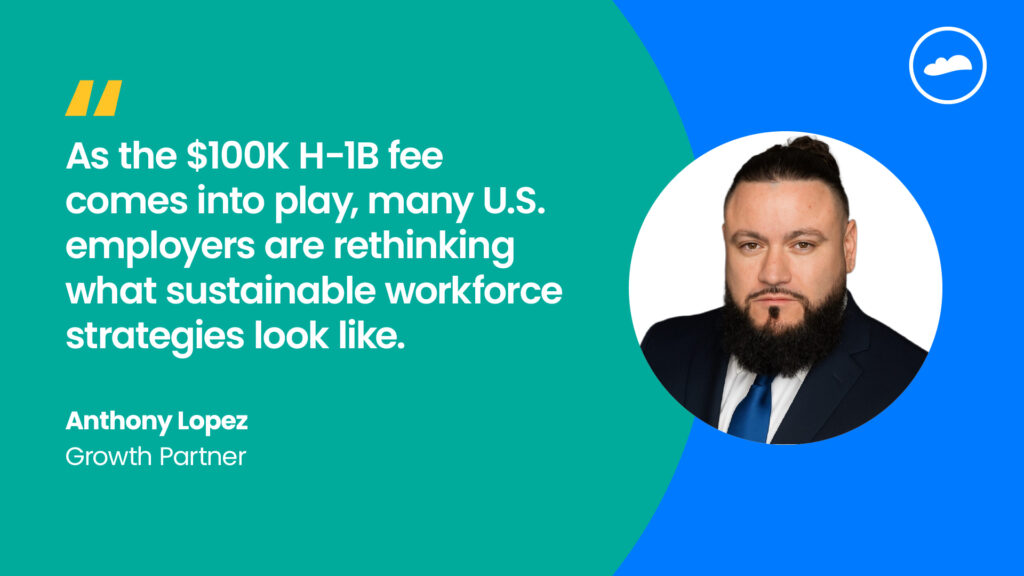
Over the past month, I’ve been having more conversations with U.S. business leaders about one thing—the new $100,000 H-1B visa fee.
The new $100,000 H-1B visa fee is prompting many U.S. employers to reconsider how they access specialized global talent. From technology to accounting, leaders are asking what sustainable workforce strategies look like in this new environment.
The Question on Everyone’s Mind
Many U.S. employers are now asking: “What are the alternatives to the new $100,000 H-1B visa fee for U.S. employers?”
That question is more than rhetorical. With the fee implemented in September 2025, companies that rely on visa sponsorship for technical and professional talent are rethinking how they’ll scale and stay competitive.
According to fwc.us, there are roughly 780,000 H-1B visa holders currently employed in the United States, with an estimated 550,000 dependents. In 2023, 65% of approved H-1B petitions (pewresearch.org) were for computer-related occupations, while in 2024, it was almost 64% (statista.com)—critical roles that power innovation across the U.S. economy.
What the Fee Means for Employers
The financial considerations extend beyond sponsorship costs. For mid-sized companies with 50 or more employees relying on visa holders, the new fee structure could affect hiring timelines, budgeting, and project scalability.
Technology firms will feel this change most directly, but ripple effects are already reaching other sectors such as accounting, debt collection, and e-commerce, all of which rely on specialized and technical roles.
New Directions for Global Workforce Strategy
Many U.S. firms are taking a fresh look at distributed workforce models—combining local teams with trusted partners abroad. Whether through nearshore or offshore operations, these approaches offer access to specialized skills, aligned time zones, and scalable delivery options without the complexity of additional visa sponsorships.
What to Evaluate Before You Transition
Organizations considering a more distributed workforce should focus on three essentials:
- Continuity: Can new teams integrate seamlessly with existing U.S. operations?
- Cost Predictability: Will this model remain stable as domestic regulations evolve?
- Compliance and Quality: Is the provider certified and transparent in its governance?
A Broader Workforce Shift
Many leaders tell me they still want access to global talent, but without the added uncertainty. That’s where strategic partnerships and smart location choices make all the difference.
This isn’t simply a reaction to rising costs—it’s part of a larger transformation in how global work is structured. As U.S. companies adapt, the most successful ones are building distributed teams that combine local leadership with specialized global expertise.
By diversifying where and how talent is engaged, employers reduce dependency on single regulatory systems, improve resilience, and keep innovation moving forward.
Building the Next Workforce Model
The future of work belongs to companies that build flexibility into their workforce strategy—something I see every day in the partners we work with. Building flexibility into your workforce strategy is no longer optional—it’s the foundation for staying competitive as global policies evolve.
About the Author
Anthony Lopez is a Growth Partner at Cloudstaff, helping U.S. companies design customized offshore talent solutions that scale efficiently while maintaining productivity and compliance. With over 10 years of experience leading enterprise sales operations and building high-performing teams, Anthony combines strategic insight with a hands-on approach to workforce solutions. He partners with forward-thinking businesses across technology, accounting, and e-commerce to reduce overhead, increase efficiency, and drive long-term success.