
Offshore hiring is no longer just a side strategy—it’s now central to how Australian businesses scale. Over the past year, one question has repeatedly surfaced for HR leaders and CFOs: “When we hire offshore, does the Fair Work Act still apply—and what does day-to-day compliance actually look like?”
I explored this in our recent webinar, Navigating Offshore Staffing Risks in a Changing Australian Legal Landscape, led by Dentons Partner Justin Le Blond and Cloudstaff CEO Lloyd Ernst. Together, they unpacked the legal and financial realities of offshore hiring, showing where the risks lie—and how to turn them around.
The Legal Reality: It Starts with the Contract
When it comes to offshore hiring, the Fair Work Act isn’t something businesses can afford to ignore. The contract, the jurisdiction, the nature of work all play a role in whether it applies.
That means asking the right questions upfront like:
- Where did the offer and acceptance happen?
- Which laws and workplace regulations apply?
- Where is the work actually performed?
If the contract is entirely offshore—work done overseas, no tie to an Australian entity—the Act may not apply. Compliance risk will follow if this isn’t clear. The takeaway is simple: offshore doesn’t mean obligation-free. Missed jurisdiction, reporting, or obligations can expose companies to audits, penalties, or Fair Work Commission breaches.
HR’s responsibility is to manage employee risk as well as spot when contractor relationships creep into employee territory. By implementing internal controls, writing clear agreements, and following the right steps, businesses can comply with workplace laws, reduce compliance risks, and protect both financial stability and reputation.
For CFOs, this isn’t about fear—it’s about foresight. Compliance risk can impact financial risk. Offshore hiring requires a plan to control exposure—or a model that transfers the risk before it hits your balance sheet.
A Safer Path: Outsourcing, EOR, or BPO Models
Offshore staff bring opportunities. Unless you have a large footprint and can invest in your own offshore corporate structure, I encourage businesses to shift from direct offshore hiring to structured outsourcing, Employer of Record (EOR), or BPO services. The benefits are clear:
- Legal clarity: The provider handles contracts, obligations, and legally required employment responsibilities, reducing compliance risk.
- Simplified compliance: HR and finance teams avoid non-compliance through proper reporting, adherence to workplace laws, and complete internal controls.
- Operational efficiency: Payroll, entitlements, company email addresses, and employee provisions are managed by experts, lowering breaches and failures.
- Strategic focus: Teams can concentrate on clients, customers, and growth—not legal disputes or daily compliance practices.
If you decide to invest in your own corporate offshore structure in the future, you do it with the learnings of experience.
Key Questions Your HR & Finance Teams May Ask
Before hiring offshore staff, HR and finance need to get clarity on the essentials—some questions you may like to ask:
- Who will provide legal advice?
- What law and jurisdiction does each contract follow?
- Where (and how) did offer and acceptance happen?
- How integrated is this worker into your company operations?
- How much control do we have over hours, tools, and methods?
- Do contracts clearly define employee vs contractor rights, and are the provisions enforceable?
- What’s the fallback if the Fair Work Act offshore staff obligations trigger a reclassification?
- At what point should we consider an outsourced service model?
These questions will help compliance, limit breaches, guide reporting, diligence, and provide proper consideration of the employment relationship.
Webinar Insights: Get Compliance Right with Your Contract
Le Blond emphasized a crucial point in our webinar: compliance starts the moment a contract is written—not after the hire. How a contract is structured, where it’s formed, and the obligations it sets out determine whether the Fair Work Act applies to offshore staff.
For HR and finance teams, this is a daily reality. Every decision around supervision, integration, and reporting carries risk management implications—miss a step, and you could face breaches, liability, or worker reclassification.
The smarter path, as Le Blond highlighted, is often an outsourcing or BPO model. Providers like Cloudstaff absorb employer responsibilities—including contracts, workplace laws, employee procedures, and internal controls—so HR and finance leaders can stay fully compliant while focusing on core operations, clients, and business growth.
Turning Compliance into Confidence for HR Leaders & CFOs
Offshore hiring is no longer exotic—it’s standard practice. But for Australian businesses, the compliance landscape is evolving fast. What seems like a minor boundary today could become a major legal fault line tomorrow.
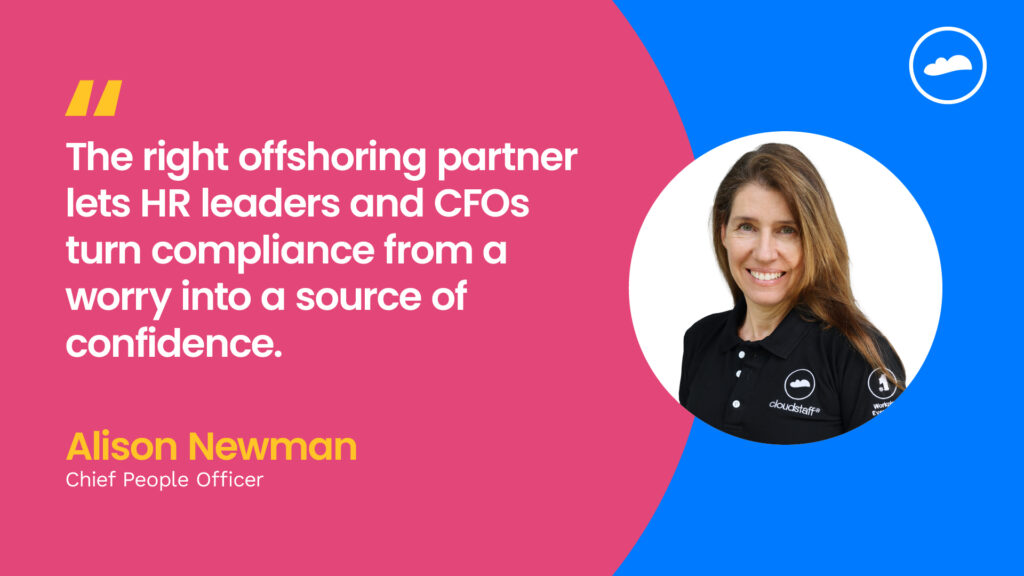
Start from clarity, not assumption. When contracts, controls, and reporting are built right from Day 0, offshore staff stop being a liability—they become a growth engine. Confidence, not risk, should drive your next move.
About the Author
Alison Newman is a seasoned HR leader passionate about building high-performing teams and creating scalable people strategies. With experience leading HR across Australia, the USA, and global markets, she specializes in aligning culture, leadership, and business growth. As Chief People Officer at Cloudstaff, Alison shapes the people agenda for a global remote staffing pioneer, fostering inclusive, future-ready workplaces where both employees and businesses can thrive.
🎥 Watch the complete webinar with Dentons Partner Justin Le Blond and Cloudstaff CEO Lloyd Ernst: Navigating Offshore Staffing Risks in a Changing Australian Legal Landscape