
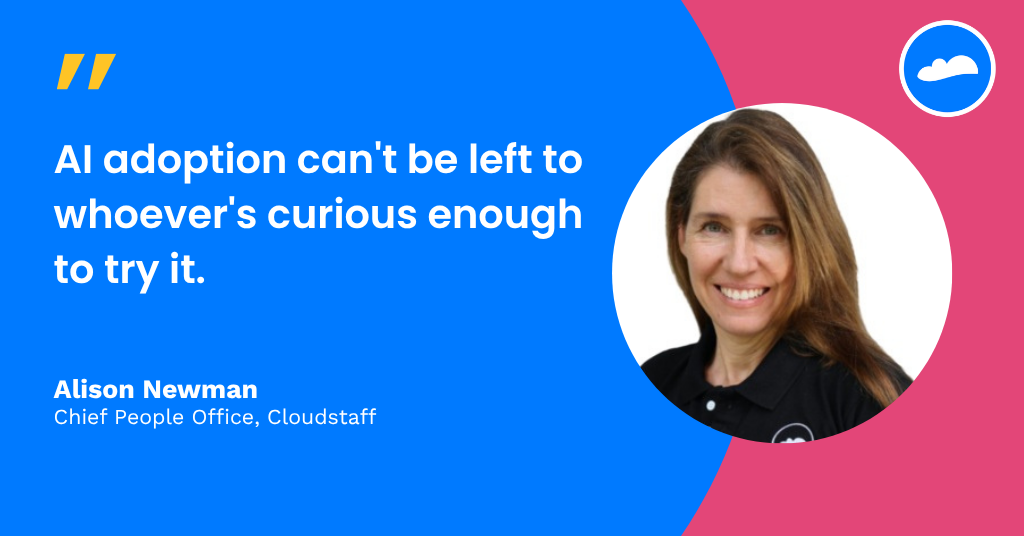
By Alison Newman
Businesses building virtual teams today are looking for people who can step straight into their workflows and use modern AI tools from day one. How well AI is woven into daily work has become one of the clearest signals of team quality, and clients notice it in how a team performs, not in how that capability gets described to them.
We know every industry has early adopters to any change. AI is no different. One team races ahead because a manager pushes for it, or because someone on the team is naturally curious. Another barely touches it simply because nobody made it a priority, or they are nervous about the unknown, or simply, are waiting for it to be standardised and for them to be ‘told’ to use it. The result is a patchwork: pockets of confident AI use sitting right alongside teams that have never had a proper introduction, often inside the very same organisation.
Structure is What Closes the Gap in AI Skills Development
Closing that gap takes more than encouragement. It takes a genuine pathway that reaches every department, not only the technical roles most people associate with AI. From our front-line teams, through to support, finance and technical teams – all need a shared baseline of confidence with these tools so the business can move forward as a whole.
This is where I think conversations about AI can be improved. There’s plenty of new AI tools to buy, and the opportunity they bring to the way we work are meaningful. It seems however there is far less attention (potentially the harder part!!) on building an actual pathway that moves an entire workforce to embracing AI.
SHRM’s 2026 State of AI in HR report, based on a survey of 1,908 HR professionals conducted in December 2025, found that just 39% of organisations have adopted AI within their HR function, and only 46% expect to be using AI in HR by the end of 2026. Adoption is concentrated in a handful of areas, mainly recruiting, HR technology, and learning and development, while functions such as inclusion and diversity, and ethics and compliance, have barely been touched. That gap, between where AI adoption has taken hold and where it hasn’t touched at all, is exactly the gap a structured training pathway is built to close.
Critical Thinking and Essential Skills for Responsible Artificial Intelligence Use
When training is standardised, rather than left to individual initiative, staff move from simply knowing AI tools exist (or waiting for the business to adopt one) to actually using them as part of how they get work done. That shift, from awareness to habitual use, is where businesses start to feel a measurable difference in output, and it’s usually the clearest sign that real AI adoption is taking hold.
But habitual use only works if people understand what they’re actually doing, and why it matters. I’ve seen the difference proper AI literacy makes firsthand: teams who’ve had it don’t just use AI tools; they question them.
They know why an AI system might get something wrong, why bias can creep into outputs, and why a human still needs to check the work before it goes out the door. That’s less a technical skill and more a judgement call, and it’s the piece that’s easiest to skip when a business rushes to roll out a new tool without the AI training to back it up.
This is why I think responsible AI use has to be taught alongside the practical stuff, not after it. It’s one thing to show someone how to use a tool. It’s another to make sure they’ve got the AI skills to understand its limits, question its output, and know when to step in rather than take what it gives them at face value.
Get that balance right, and you’ve got a workforce that isn’t just AI-literate on paper. They’re actually using these tools and using them well.
Enhancing AI Training with Expert-Led Programs and Practical Applications
Buying access to AI tools is the easy part. The harder part, and the part I think gets skipped too often, is making sure people actually know how to use them well. That’s why I don’t think AI training should be left to a quick how-to session or a PDF nobody reads. It needs to be expert-led, and it needs to actually stick.
Good training does two things at once. First, it gives people practical grounding in how these tools actually work, what they’re good at, and where they fall short. Second, it builds the judgement to apply all of that in real situations, not just the theory of it.
I’ve seen teams go through training that only covers the “how” and completely skip the “why,” and it shows: they can follow a prompt, but they can’t tell when the output is wrong, or biased, or just not good enough to use as-is. This kind of training helps people learn to apply AI thoughtfully to everyday tasks, improving problem solving and supporting research efforts across the organization.
Where This is Headed: Ongoing AI Essentials Training
As AI tools keep evolving, so will the skills teams need to leverage AI tools effectively. Providers who treat training as an ongoing pathway, rather than a single certification milestone, are the ones positioned to keep pace as expectations shift and stay ahead.
At Cloudstaff, for instance, we’ve built a company-wide AI literacy and certification program that spans every department, from our front line to our operations and support teams through to our technical teams.
I’ve seen firsthand what happens when training reaches everyone at once rather than trickling through informally. It changes how a team shows up for their business, not just what it knows.
It’s this kind of expert-led training that actually builds new skills people can use on the job.
As AI reshapes what a virtual team can deliver, the virtual staffing partners investing in structured, sustained training pathways for their people are the ones likely to keep up with the real-world applications of AI and where the work is actually headed.
About the Author
Alison Newman is a seasoned HR leader passionate about building high-performing teams and creating scalable people strategies. With experience leading HR across Australia, the USA, and global markets, she specializes in aligning culture, leadership, and business growth. As Chief People Officer at Cloudstaff, Alison shapes the people agenda for a global remote staffing pioneer, fostering inclusive, future-ready workplaces where both employees and businesses can thrive.
Cloudstaff ensures that dedicated teams are fully equipped and prepared to excel in an AI-world.
Find out more more: Cloudstaff Academy: Training and Upskilling Remote Teams