
Australian real estate and strata management businesses are operating in a very different environment than they were even a few years ago.
Legislation is tighter. Oversight is stronger. Expectations around record keeping, communication, trust processes, safety, and governance keep climbing. For many businesses, the real challenge is having the time, people, systems, and resources to keep up properly.
That is where the strain is really being felt.
Real Estate and Strata Management Australia: The Pressure is Real, and it is Documented
This shows up clearly in the numbers.
In NSW, a staged overhaul of strata law is well underway. Reforms that started on 27 October 2025 strengthened NSW Fair Trading’s investigation and enforcement powers and introduced new financial hardship protections for property owners in strata communities. A further round commenced on 1 April 2026, bringing standard forms for initial maintenance schedules, expanded strata information certificates, and updated capital works fund plans (NSW Government). More reforms are already flagged for later in the year. Reforms affecting owners corporations, common property, repairs, fees, insurance, and building defects continue to reshape expectations.
NSW Fair Trading’s own Strata and Property Taskforce has been active in enforcing the reforms, with strata managers, property managers, and property management services all under greater scrutiny. In its first year, the Taskforce completed more than 175 investigations, issued close to 80 fines worth over $125,000, and took disciplinary action against more than 70 licensees across real estate, strata management, and conveyancing, removing more than 10 operators from the industry altogether. For strata managers and property managers, professional service and service excellence now matter even more.
Real estate professionals have also picked up a new obligation entirely. Since 1 July 2026, agents who broker the sale or purchase of property are AUSTRAC reporting entities under the AML/CTF Act’s Tranche 2 reforms, with customer due diligence, record keeping, and reporting duties that did not exist before. Add in staged fire safety upgrades under AS 1851 and building manager disclosure duties, and property management teams have a lot of new ground to cover in a short window.
Compliance Rarely Sits in One Neat Box
In Australia, state-based regulations differ, and in real estate and strata management, compliance touches everything from owners corporation obligations and common property repairs to fees, insurance, and building defects. That means administration, documentation, financial processes, maintenance workflows, owner and tenant communication, meeting preparation, reporting, and the day-to-day follow-up behind all of it. As obligations grow, so does the amount of work required behind the scenes to stay on top of them.
For many businesses, the real risk is capacity.
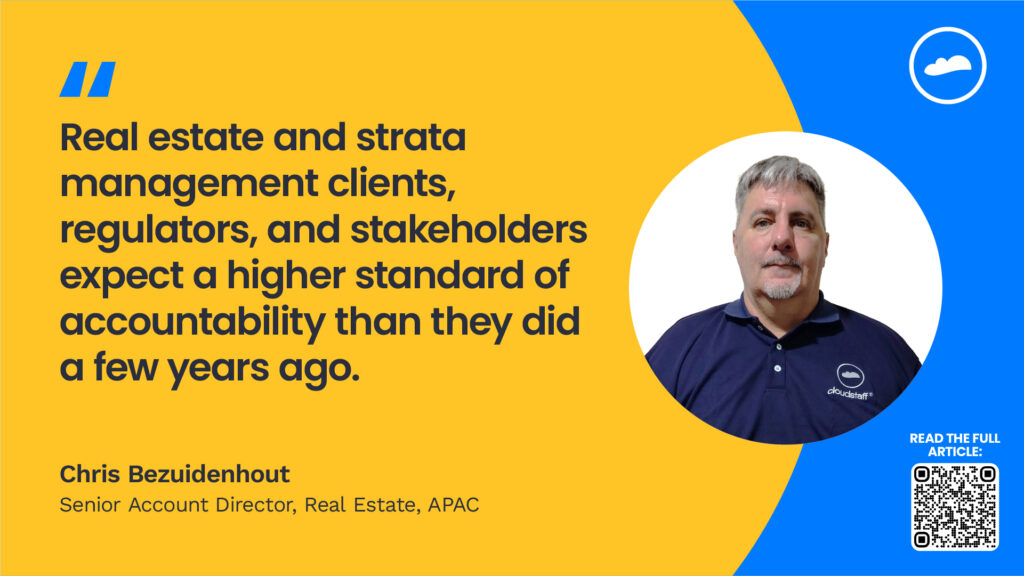
Good people are already stretched. When experienced local teams are overloaded with admin-heavy work, the chances of delays, missed details, and inconsistent processes naturally increase. That creates pressure not only internally, but with clients, regulators, and stakeholders who expect a higher standard of accountability than they did a few years ago.
Why More Agencies Are Rethinking How Their Teams Are Built
This is one of the reasons more Australian real estate and strata management businesses are looking at global staffing support in a more serious way, as a means of strengthening the local expertise they already have.
With the right structure, a well-built global team can take on the operational work that sits behind compliance-heavy environments. Things like administration, document handling, accounts support, maintenance coordination, CRM updates, reporting preparation, and customer communication. That frees local teams to spend more time on oversight, client relationships, and the work that genuinely needs to stay onshore. The right support helps local teams lead better client relationships and deliver more consistently.
This is where I see offshore staffing providers like Cloudstaff are in a strong position to help.
What makes the difference is the way a business builds dedicated support around the team it already has. The right approach is focused on finding people who fit the role and the business.
For real estate and strata management businesses, that distinction matters. These are industries where accuracy, consistency, responsiveness, and attention to detail are essential, and where a poorly integrated hire can create as much risk as the compliance gap it was meant to close. Getting the structure right, so new team members are properly onboarded, trained, and folded into day-to-day operations, is critical in an environment where processes need to be followed carefully and reliably.
Less About Headcount, More About Capacity
As legislation and oversight continue to increase, I think this becomes less about adding headcount and more about giving businesses the support they need to operate well.
Managing complexity is the real challenge ahead, more than managing growth on its own. The real estate and strata management businesses that build the right support around their existing team, rather than asking that team to simply absorb more, will be in a far stronger position to handle both. That comes down to commitment, responsibility, and respect for the work that keeps the business running
I would be interested to hear how others in the industry are dealing with the growing compliance load, and where additional support is making the biggest difference for your business.
About the Author
Chris Bezuidenhout, known to colleagues as Dutch, is Cloudstaff’s Senior Account Manager for Strata & Real Estate, APAC. He has spent 25 years in the offshoring industry across South Africa and the Philippines, and works with agency principals across Australia to build teams that handle the operational and compliance load so local staff can stay focused on clients, owners, and the work that needs to stay onshore.